Read this book once when nothing is demanding your attention. Return to it when something is.
The first reading builds the route through the ideas. The later reading is more practical: a chapter can help recover a question, check a habit or give a Fleet Member enough context to understand a decision. The handbook is meant to move between those two uses without requiring the whole route through it each time.
First Passage
Begin with the Introduction and follow the chapters in order. The early pages establish the language used later for routes, observations and uncertainty. You do not need to memorise each detail. Pay attention to the places where the book changes the meaning of something familiar: an empty Local window, a scan result, a Bookmark or a route that was reliable a few minutes ago.
Keep your own experience close. If the text and the client appear to disagree, do not force one into the other. Note the difference and verify it. A field manual remains useful only while it can survive contact with the field.
Reading the Terms
Several ordinary words carry narrower operational meanings in this handbook. Capital letters keep those meanings visible.
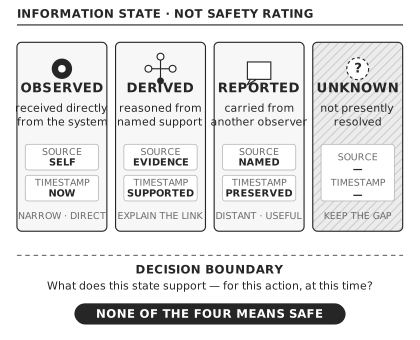
Observed, Derived, Reported and Unknown name information states.
Observation, Source and Timestamp identify the evidence, origin and age
supporting a record. Grid, Chain and Home name the immediate space, the
known shape of access and the destination an operation intends to reach.
Lowercase uses retain their ordinary meaning. Pilots can observe something
without yet preserving an Observation; a system may be unfamiliar without
every empty field becoming Unknown. The distinction is functional, not
decorative.
In the Field
Do not read a page while the situation requires you to fly the ship. Use the chapter titles and contents to prepare before an operation or to review one afterward. During quieter moments, return to the passage that explains the question behind the action rather than searching only for the next command.
The book returns to one working rhythm: observe, record, understand, evaluate, decide, act and observe again. Its pace changes with the situation. The same rhythm can occupy a few seconds on a Grid or follow an entire route through a changing Chain.
After Return
Review decisions as well as outcomes. A safe return does not prove that the reasoning was sound, and a loss does not prove that every decision was wrong. Ask what was known at the time, what was only assumed and which change made the old picture unusable.
This is also the right moment to improve Bookmarks, notes and shared records. The next pilot should inherit the Observation and its age, not merely the confidence of the person who recorded it.
Keep It Current
EVE Online changes. Interface labels, values and mechanics in this edition are checked during publication, but the live client and current official sources remain authoritative. Examples in the handbook explain relationships; they are not live intelligence or a promise that the next system will repeat them.
Use community tools and shared maps as extensions of memory, not replacements for judgment. When a record is old, mark it as old. When a fact is unknown, leave room for it to remain unknown.