The ship is not expensive enough to worry anyone.
It is an ordinary transport hull, already in Home and ready for the next movement. Replacing its market value would not threaten the group. The asset list therefore treats it as a small line among larger ones.
Then a pilot asks what happens if it is unavailable.
The ship is the only hull currently prepared to move fuel and working material through the routes the group expects to use. It is also part of the plan for removing assets if the trial in Home ends. Another hull could fill the role, but that replacement is outside the current Chain. Bringing it in would require a route, time and a pilot able to complete the movement.
The price of the ship has not changed.
Its weight has.
What Stays Behind
An inventory answers what is here. Commitment asks what the listed objects have been made responsible for.
The distinction begins with ownership. A personally owned hull, a stack in a corporation hangar and an item available through another pilot may all appear to support the same work. They do not offer the same control. The person who can see an item may not be able to remove it. The person able to remove it may not own the decision for which it was reserved.
Corporation Roles make these differences concrete. Rights to view a hangar, take its contents or remove containers are separate permissions. Management and Industry Roles grant other abilities. A shared label on a hangar does not make every item equally available to every member.
Chapter 7 will examine access in detail. For now, the important point is that an asset record must preserve both owner and usable capability. Corporation asset is too broad when one pilot can see the item, another can take it and a third believes it has been reserved for common work.
Purpose comes next. What does the object allow the group to do? The transport hull enables movement. A scanning hull enables the Chain to be rebuilt. Fuel keeps a required service from becoming only an icon in a plan. A Blueprint may represent future work that also depends on materials, access and an available service.
This view catches unfinished work as well as stored objects. Materials set aside for a job, a loaded ship waiting for a pilot and an asset promised to a later shift all bind future decisions. They may still appear in the same place, but they are no longer unassigned.
Chapter 1 named purpose, carrier, visible condition, failure and intended end for any commitment. An asset record sharpens that method through five practical questions:
Who owns it? What capability uses it? Where is its replacement? What else fails at the same time? How can the exposure be reduced?
These are not fields for every piece of ammunition or every inexpensive tool. They belong to assets whose absence would change the plan. The purpose is not to build a perfect inventory. It is to find the small number of lines carrying more work than their price suggests.
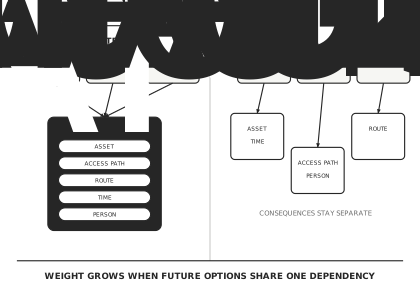
The transport hull becomes visible under this test. It belongs to one pilot, supports several shared movements and has no immediately available substitute in Home. Losing it would not create the largest financial loss. It would break the most promises at once.
That difference changes the conversation before anything is moved. The owner may be comfortable risking the hull while the group is not comfortable losing the work attached to it. Neither judgement cancels the other. One describes personal tolerance; the other describes a shared dependency. They must be made visible before consent to one is mistaken for consent to both.
The record does not need to price that disagreement. It needs to show where the promises divide. The owner can accept the hull’s loss. The fuel movement can be assigned elsewhere. The withdrawal plan can name another method. Once those decisions are separate, the object returns to being an ordinary asset instead of a quiet answer to three different problems.
Commitment should therefore be reviewed at the moment an asset receives a new purpose, not only when it first enters Home. A hull that arrived as a spare can become essential after one fitting change, one depleted reserve or one departed pilot. Inventory changes are visible. Changes in responsibility often are not.
Replacement Has Distance
Replacement is often spoken of as though it were a purchase. In Anoikis, the object is only the beginning.
A replacement must exist, be available to the intended owner and reach the place where its capability is needed. Each step can add distance. The market may be close in Known Space while the current route is unsuitable. A hull may already exist elsewhere but require a pilot, access and time that the group does not have when failure occurs.
Distance is therefore measured in decisions as much as in systems.
Start with availability. Does a replacement actually exist, or does the plan assume that one can be obtained? Is it controlled by the same person who is expected to use it? Does fitting, loading or transferring it require another capability that may fail with the original asset?
Then read the route. Wormhole Connections are short-lived and carry limits on individual transits and total mass. The current Chain may support a replacement movement now without promising that the same movement will remain possible. An asset outside Home is not a usable fallback until the route needed to bring it in has been observed for the actual movement.
Next comes time. How long can the group operate without the capability? A replacement path that takes several sessions may be adequate for optional work. The same path is weak if scanning, access to stored assets or a planned exit depends on the missing object immediately.
Finally, name the people. A replacement may require someone with the correct asset access, a pilot able to move it and a person authorised to alter the plan. If all three roles belong to one absent member, the object is not the only concentrated dependency.
This is the non-financial side of replacement. A group can own several hulls and still have only one usable capability. The limitation may be a role, a Timestamp, a Bookmark, a decision or a person who knows why an item was placed where it is.
The solution is not to duplicate everything. Duplication without separation can create a larger pile exposed to the same failure. A replacement becomes meaningful when it survives the condition expected to remove the original.
That condition should be stated plainly. If the expected failure is the loss of a hull in flight, another hull in Home may be enough. If the expected failure is lost access to Home, the same reserve is no reserve at all. Expected owner absence changes what counts as a fallback: another personally controlled asset repeats the dependency even when it sits somewhere else.
A group can test this without staging a disaster. Choose one required capability and pretend that its primary source is unavailable. Begin from the records, people and routes that would remain. Who notices the absence? Who can authorise the fallback? What must move before the capability works again? The exercise ends when the group can act, not when someone points to another item in an asset list.
The answer may reveal that no additional purchase is needed. A Bookmark may need to be shared, an existing hull reassigned or a second pilot given the context to use what is already present. Replacement distance is shortened by removing decisions and dependencies as surely as by moving an object closer.
For the transport hull, a second identical ship beside it may protect against one mechanical loss. That duplicate offers no protection against lost access to the Structure, a route unable to carry the movement or an absent pilot who owns both hulls. The useful question is not whether another object exists. It is whether the capability can be restored from the fallback state the group expects to have.
Concentration Changes Loss
Concentration allows Home to work. Ships, materials, records and services are brought together because proximity reduces effort. The same arrangement also allows one event to reach several commitments.
Financial concentration is the most visible form. Many valuable assets in one place can be exposed together. Yet market value is only one measure. Capability can be concentrated even when the objects are inexpensive.
The transport hull carries movement, fuel delivery and part of the exit plan. Three purposes have gathered around one asset. A second ship would help only if it remained available under a different failure. Otherwise, the group has added value without separating capability.
Location is another form. Personal and corporation assets may have different owners but share the same Structure, access path and route out. Counting them separately does not change the fact that one lost location or access condition can affect them together.
Time can also concentrate exposure. Several independent movements may be reasonable on their own. If they all depend on the same ageing Connection, their risk is no longer independent. The route is being asked to carry several commitments before it changes.
People create concentration when one person holds several required abilities. The member who owns the transport hull may also be the only person able to remove the relevant corporation assets and the only one who knows which materials were reserved. Nothing needs to be destroyed for that capability to disappear. Absence is enough.
Information can fail in the same way. A list may record every object while leaving purpose and owner in one person’s memory. The inventory survives, but the group no longer knows which asset can be spent, moved or abandoned.
Read concentration by asking what would fail together. Do not begin with a hypothetical catastrophe. Begin with one unavailable hull, one changed access condition, one unusable route or one absent person. Trace the plan as the first effects unfold.
Follow those consequences only as far as the group would have to respond. Perhaps hauling pauses, which delays fuel, which turns a planned work period into a recovery movement. Perhaps access remains intact but the only pilot who understands the reservation list is absent, so no one can tell which material may safely be consumed. The first event is small; the accumulated obligation is what gives it reach.
Separate records can conceal that reach. A personal asset list, a corporation inventory and a movement plan may each look reasonable. Their shared dependency appears only when they are read together. The same hull can be a minor personal exposure, a required corporation capability and the unspoken link in a departure plan. No individual record is false. The conclusion drawn from reading each one alone is incomplete.
If several commitments stop at the same point, that point carries more weight than its isolated value suggests.
Reduction can take several forms. Separate a fallback from the primary location. Give another person the access and context needed to use it. Avoid loading several urgent movements onto the same Connection. Remove old assets before new ones turn a trial into an accumulation.
None of these actions removes loss. They reduce the number of capabilities that must be recovered at the same time.
Recovery Is Different
The phrase Asset Safety can create the wrong picture when carried into Wormhole Space from elsewhere.
Upwell Structures in Wormhole Space do not use the standard Asset Safety system. In circumstances that elsewhere lead to Asset Safety, affected assets are instead ejected into space and become available for any player to collect. This applies to personal and corporation holdings affected by that event.
The consequence is simple and severe: storage in a Wormhole Structure must not be treated as a delayed recovery service.
This does not mean every stored asset will be lost. It means the plan cannot claim the ordinary Asset Safety outcome as its fallback. The plan must account for what can be lost together, what can be removed deliberately and which capability must exist outside the exposed location.
Ownership still matters. Personal assets and corporation holdings have different decision makers and access paths before a loss. A corporation hangar may preserve a shared purpose while limiting who can act. A personal hull may be quickly controlled by its owner but unavailable to everyone else. The Wormhole-space outcome does not erase those distinctions; it makes them more important before recovery becomes impossible.
The word recovery should therefore be used carefully. It may mean replacing the capability from elsewhere, moving exposed assets while access remains, rebuilding records or accepting that a planned reserve has gone. It should not quietly mean that the same items will later be delivered to a convenient place.
Those meanings lead to different preparations. Replacement needs a surviving source and a route. Deliberate removal needs a trigger early enough to act. Rebuilding records needs copies that do not share the lost access path. Acceptance needs the owners to understand what can disappear before their assets are committed. Calling all four outcomes recovery hides the decision until the group has the least room to make it.
The useful preparation is therefore made while Home still feels ordinary. Name which response belongs to each important commitment. For replacement, identify the source. Deliberate removal requires a condition that starts it, while acceptance requires explicit exposure. A vague hope to recover later is not a fourth option.
The difference changes how value is recorded. An expensive object that has a separated replacement may be survivable. A cheap object that controls the only route to replacement may be critical. A large shared store may be manageable if each owner understands the exposure and work can continue without it. A small store may be too heavy if its loss strands every remaining asset behind the same missing capability.
Asset Safety is not the only reason to limit concentration. Connections, access, people and time already make that necessary. The Wormhole-specific outcome removes one comfortable assumption and makes the remaining plan visible.
Set Exposure Limits
There is no universal amount of ISK that a resident may safely leave in Home. The same number can be trivial to one group, irreplaceable to another and misleading to both.
An exposure limit should describe capability before price.
Ask what the group must still be able to do after the accepted loss. Can it scan and rebuild the Chain? Each owner should be able to reach a useful fallback. Work should be capable of pausing without creating another emergency. It must also be clear whether the group can remove what remains or the exit plan has failed with the first asset.
The answers define a fallback state. It might be reduced work with scanning and departure still available. Another valid state is a full pause while replacement is brought through a newly observed route. The group may instead decide to end the trial before another asset enters Home.
A useful limit can be spoken without a price: No single loss may remove both our working capability and the means to replace it. Another group may choose: Only assets whose owners can accept total loss remain behind guest access. The wording differs because the commitments differ.
Apply the limit to simultaneous exposure. One movement may be acceptable while three similar movements would depend on the same route. A reserve may be reasonable until the primary and fallback are placed together, defeating the distinction. An absent specialist may be manageable until every recovery action waits for that person.
Then define reduction triggers. Stop adding assets when the fallback becomes unclear. Move or consume old stock before a second purpose claims the same reserve. Separate personal property from corporation responsibility. Confirm who can view, take and move shared holdings before the capability is needed.
The group should also name who can invoke the limit. If everyone can recognise excess exposure but no one can pause the movement, the limit is commentary. Authority and responsibility must meet before the next asset crosses.
Limits also need a moment of review. The trial may begin with little in Home and a clear fallback, then acquire materials, specialised hulls and unfinished jobs one reasonable movement at a time. Nothing crosses a dramatic threshold, yet the preserved capability gradually becomes dependent on everything that was added. A review after a major movement, access change or new shared purpose is more useful than waiting for a calendar date.
The review can be brief. Read the current commitments aloud, remove the primary capability from the picture and describe the state that remains. If the group can still pause, scan, decide and restore what it chose to preserve, the limit still describes reality. If the explanation depends on the missing asset returning, on an unconfirmed route or on an absent owner responding, the group has already crossed it.
Excess exposure does not always demand evacuation. It may call for finishing one job before starting another, returning borrowed capability, reducing a reserve or moving a record beyond the access it describes. The smallest action that restores the fallback is often better than adding another object to solve an obligation created by too many objects.
Return to the transport hull. Its market value remains ordinary. Under the exposure limit, however, it cannot be the only prepared movement capability, the only fuel carrier and the assumed method of withdrawal at the same time. One purpose can be separated, a fallback prepared elsewhere or the assets that depend on the hull’s return reduced.
The correct action is not determined by the hull. It is determined by the fallback state the group has chosen to preserve.
Field Principle
Value becomes weight when several future choices depend on the same asset, access path, route, time or person.
Record ownership, purpose, replacement distance, simultaneous failure and the available reduction. Do not count a replacement unless the group can restore the capability from the state expected after loss. Do not count standard Asset Safety as that state for an Upwell Structure in Wormhole Space.
Set exposure limits around what must remain possible, not around a universal price. Then reduce commitment before the first loss removes both the work and the way back from it.
Once several people use the same assets and records, the next problem is no longer weight alone. The question becomes what is genuinely shared, who tends it and which assumptions access does not justify. Chapter 4 begins on that shared ground.