Departure was chosen on an ordinary day.
The Chain had been observed. The Structure remained accessible, its supported Services were known, and no active hostile pressure forced the timetable. Pilots could still choose which ships moved first, which jobs ended and which records stayed available until the last handover.
That calm made departure feel premature.
Home was still functioning, but the group could no longer maintain its promised scope across the coming period. Fewer people had accepted routine ownership. Replacement relied on a Service whose support had narrowed. Too much value had accumulated in one Structure for a purpose the group no longer intended to continue. Remaining would convert a known decline into a later emergency.
A deliberate exit begins before leaving is the only possible response. It ends new commitments, separates what must move from what may remain, closes jobs and access, and verifies the result. If the Structure is decommissioned, that action becomes one exposed part of the exit rather than a button that performs the whole departure.
Exit Starts Early
The first exit decision is not when to begin decommissioning. It is what Home will stop promising now.
An operation can leave while ships, Services and storage still work. That remaining capability is the resource that makes order possible. Pilots can move value in consequences rather than in one improvised concentration. Industry owners can close or decline jobs before more inputs become committed. Administrators can test access while both the old and receiving owners are available. Chain observations can support planned movements without being asked to guarantee them.
The decision needs a bounded reason. “We may leave someday” cannot stop the next job. “The group will end this Home because it cannot sustain the accepted Service, handover and reserve obligations after the named period” connects the departure to current capability. It also prevents every temporary inconvenience from reopening the larger question.
Set an end state before choosing individual movements. Will the Corporation retain the Structure under a smaller purpose, transfer responsibility through an authorised process or decommission it? Which people and assets should no longer depend on this Home? Which records must remain available after the last ship moves? The answers determine whether a task closes, transfers or remains.
The exit also has a boundary. This chapter covers planned departure while the group can still observe, choose and hand over. Tactical evacuation, Structure defence and response to eviction remain outside its scope. Active hostile pressure changes timing, information and priorities and belongs to Survivor. Calling a crisis “a faster planned exit” would conceal that difference.
Early departure can feel wasteful because functioning capacity remains. That capacity is not wasted. It is spent on clean closure. The ability to choose a route, release permissions and receive cargo is exactly what late departure loses first.
Name an exit owner and owners for each dependency stream. One person maintains the overall end state. Others can own people and ships, Industry work, stored assets, shared information, Structure Services and access closure. Several functions may rest with one Character, but none should disappear inside the general phrase “we are moving out.”
The opening day becomes the first day of exit not because something dramatic happened, but because the group chose to preserve the options still visible.
An exit plan should show its irreversible points. Announcing departure can change whether people bring assets in. Cancelling a job can change the material state. Moving the last local scanner can remove an observation capability. Starting decommissioning exposes a Structure process whose completion still requires collection. Place a review immediately before each of these changes, while the previous state can still be retained.
Reversibility does not mean indecision. The group approves the end state once, then checks whether current evidence still supports each step towards it. A changed Chain may alter movement order without reopening the reason to leave. A missing receiver may delay one asset class without permitting new production. This separation keeps the plan responsive without letting convenience dissolve its boundary.
Stop New Commitments
Departure fails when incoming obligation outruns outgoing capacity.
Stop adding work whose closure extends beyond the exit plan. Resource operations may create cargo that still needs transport and storage. Additional Industry jobs may commit materials to a Service scheduled to end. Granting guest access creates another path administrators must later remove. Ships arriving at Home add more hulls and pilots to the return account.
Stopping does not require ending every current action immediately. It marks the point after which each new commitment needs explicit proof that it closes within the end state. A small task needed to complete departure may continue. Optional production or accumulation does not inherit permission merely because the Structure remains online.
Create an open-commitment record. Begin with ships and people outside, then add installed or prepared jobs and material in transit. Record Services with dependent work. Include guest access, shared folders, containers and unresolved ownership paths. For each, name the closure condition, owner and next check. The record is not a complete asset inventory; it captures the promises that can keep the exit open.
Then prevent silent additions. The people who approve jobs, move shared assets or grant access need to know that the state has changed. A note visible only to the exit owner cannot govern actions elsewhere. The announcement states which new commitments have stopped and how a necessary exception is approved.
Exceptions should reduce the exit rather than create a new Home inside it. A job that produces a tool required for final movement may be justified if its Service support, receipt and closure fit the plan. A profitable job with no role in departure adds time and material consequence even if it could finish. The distinction is purpose, not yield.
Existing jobs need factual states. Some may complete before Services close. Some may be paused and require a decision. Removal of an appropriate Service or destruction of the Structure can cancel affected work; do not assume an open job will quietly become output during decommissioning. The authorised owner checks the current job and chooses completion, cancellation where appropriate or another supported path.
As the influx stops, the exit account becomes smaller. Every closed job, received ship and removed access path is one less condition the last day must carry.
The record needs states that cannot be confused with progress percentages. An entry is open, held, transferred, closed or accepted as remaining. “Nearly done” can conceal the single permission or receiver that still keeps a whole dependency alive. A held entry states why no action proceeds and what evidence will release it. Closed means the final user or owner has confirmed the result, not that a movement was merely attempted.
Review the account before approving each exception. If a proposed action adds another open entry without closing a more consequential one, the exit is growing. That may occasionally be necessary, but it requires an explicit owner and ending rather than borrowing the general authority of departure.
Separate Asset Classes
Assets leave according to consequence, ownership and intended end state.
A single inventory total cannot provide that order. First separate usable reserves, personal property and Corporation property. Distinguish Industry inputs from completed outputs. Record installed or Structure-bound components, expendable surplus and records. Add the people and ships whose location remains part of the account.
Personal assets belong to their owners’ decisions, but the exit cannot silently promise to move them. Inform owners of the end state and the boundary after which the current storage path is no longer supported. Record only the operational consequence of anything that remains; do not turn the shared exit into surveillance of private inventory.
Corporation assets need an authorised owner and destination. The destination must include usable access, not merely another Structure name. Test receiving hangars and containers with unimportant items before critical stock moves. Preserve the ownership context needed by the people expected to use the result.
Replacement-critical assets move in a sequence that keeps the exit capable. Scanning, route observation, transport, access and closure may depend on local ships or tools until late in the plan. Moving every essential item first can leave a depleted Home unable to complete the remaining departure. Leaving every essential item until last concentrates consequence. Identify a working set and a recovered set so that capability exists on both sides of the movement.
Industry assets require the job path to be closed. Inputs reserved but not installed can return to an accessible inventory state. Installed work needs a current decision from its job owner. Completed output must be received and assigned a destination. A Blueprint should not be counted as free merely because the output is still waiting.
Surplus should not borrow priority from quantity. Material without a continuing purpose may move when capacity and route evidence permit, transfer through an authorised decision or remain as an accepted loss. The exit plan names that choice. Optional volume cannot be allowed to delay people, critical reserve or access closure.
That recovery boundary also governs assets left behind. “Leave it for Asset Safety” is not a general exit destination here. Explicit acceptance is required for every asset class left attached to the Structure.
The movement record follows Chapter 11. It limits concurrent consequence, accounts for Connection mass and lifetime signals, confirms receipt and updates both source and destination inventories. The fact that departure has been announced does not reserve the Chain.
Each class needs a point after which its old location is no longer considered supported. Until that point, the owner maintains access and state. Afterwards, anything remaining carries an explicit outcome: later collection under a new plan, authorised transfer, or accepted residue. This prevents the last few objects from keeping the entire Home conceptually open after its operational purpose has ended.
Do not let easy cargo displace consequential cargo merely because it can be moved quickly. Sequence first protects people and the tools needed to continue the exit, then restores capability at the destination, and only then spends remaining route capacity on optional volume. Changes in the current Chain can alter that order, but every change should preserve the functions required for closure.
Unanchor Is Exposure
Decommissioning is not disappearance.
Current Upwell procedure restricts the decommissioning action to the owning Corporation’s CEO or a Director. The process is announced over time rather than resolving immediately. It can be cancelled before completion, which resets the process. These facts make authority, timing and confirmation part of the exit plan.
The authorised Character should not begin the process merely because “most things are gone.” Confirm the asset-class decisions, open jobs, remaining people, receiving access and the owner of the final result. Record who can cancel or complete the decision and what evidence would justify doing so.
During decommissioning, the Structure and anything still dependent on it remain exposed to changing conditions. Access can change. Routes can close. The Structure can become unavailable through events outside the planned process. Defence during that period is not taught here. The exposed interval supplies another reason to reduce dependence before activation.
Completion also leaves work in space. Official procedure leaves the Structure itself available to be scooped, and a container can hold items such as modules, charges, the Quantum Core and fighters for collection. Rigs do not return in the same way. The exact current result must be checked before action; the essential planning fact is that somebody needs a ship, access, time and a route to receive what the process leaves.
The same Asset Safety exception applies alongside this outcome. Decommissioning does not turn unresolved storage into guaranteed private delivery.
Assign the collection as an operation of its own. Name the authorised decision owner, observer, receiving pilot, destination and confirmation. Define what the group will do if the intended route or receiver is not available at completion. Do not place the only copy of the record, required access or receiving capability inside the Structure being ended.
Avoid exact timers in the enduring manuscript when they are not needed for the lesson. The person performing the current action uses the current official procedure and visible client state. The book preserves the dependencies: authority, announced process, exposed interval, collection and Wormhole asset outcome.
Decommissioning is therefore late in the exit. It ends one Structure object after the group has already ended most of the commitments that made that object Home.
At each review, compare the process with the end state. Confirm that no new job or access promise has appeared, collection remains owned and receiving storage still works. If those conditions fail, the authorised decision owner chooses whether to correct the surrounding plan or cancel the process while cancellation remains possible. Momentum is not evidence that completion is still the best supported action.
The final collection should have a read-back like any other handover. The receiving pilot identifies what can be collected, the destination and the condition that ends responsibility. The exit owner records what was actually received and what remained. This keeps the visible disappearance of the Structure from substituting for an asset report.
Close Shared Access
An exit moves information and permission as well as assets.
Routes, tactical locations, working Sites and historical observations may remain in Shared Location Folders. Structure access may be granted through Profiles and Access Lists. Corporation roles may allow asset or Industry actions. Guest relationships may depend on rules whose original owner is no longer present.
Begin by classifying the purpose that remains. Preserve information needed by people still returning or collecting the final result. Transfer continuing records to their next group or reference. Expired working information should close. Removing everything at the announcement would blind the exit; leaving everything indefinitely would preserve access without purpose.
Each shared item or access path needs a last user and an ending condition. The return folder remains online until every named pilot is accounted for. The receiving record becomes authoritative before the old one closes. Temporary guest access ends after the accepted movement and confirmation. A role used for final collection is reviewed after receipt.
Closure follows specificity. Access Lists can combine broad and specific entries, and more specific entries can override general ones. Removing one name does not prove the whole user path is closed if Corporation, Alliance or Everyone entries still grant a relevant relationship. An authorised administrator reviews the configured result, while a test Character confirms the intended loss or retention of access where appropriate.
Do not delete evidence that the group still needs to explain decisions. A historical route record can remain in the Shared Map without presenting itself as a current Chain. An inventory can preserve what was accepted as remaining without claiming it is recoverable. The exit report distinguishes archived history from live instruction.
Ownership of tools matters. A personal document or account can vanish from the group when its owner leaves, even if access remained open during the exit. Move the required record into an authorised continuing context before closing the old path. The field manual does not prescribe which tool should hold it; it requires the next owner to confirm availability.
Finally, remove temporary permissions and mark the date and scope of closure. Do not retain broad rights as an undocumented fallback. If later access is needed, it should begin as a new explicit purpose under the state that exists then.
Order closure from the outside inward. End optional guest and working access once its last action is confirmed. Preserve the narrow paths required for return, receipt and Structure collection until their owners close them. Transfer the authoritative record before the old editing path disappears. This order keeps the exit observable without leaving every historical permission active until the last minute.
After removal, verify the result from both sides where possible. An administrator sees the configured state; the former user confirms that the old path no longer works or that the retained path still serves its purpose. A configuration change without a user-path test is an action, not yet closure.
Verify the End
Departure ends when no hidden promise still points towards the old Home.
Verification begins with people. Account for the pilots and ships the exit record named. Confirm whether each arrived at its destination, transferred to a new owner or remains an accepted open exception. “Everyone should be out” is not evidence.
Next follow work. No job should remain counted as expected output without an owner and supported receipt. Services no longer promised are recorded as closed. Inputs and outputs have a final ownership state. The replacement record describes the continuing capability outside the old Structure.
Then follow assets by class. Corporation stock reached tested access or was accepted as remaining. Personal owners received the boundary and no shared plan silently guarantees their property. Installed components and the result of any decommissioning have named collection outcomes. Source and destination inventories agree on the movement that occurred.
Information follows. Live Shared Locations needed for return have been closed or handed over after their last user. Historical records no longer present old Connections as current. Profiles, Access Lists, guest entries and temporary Corporation roles have been reviewed by authorised people. Continuing owners have confirmed the records they inherit.
Treat the Structure as the final object, not the only object. A retained Structure receives a new Baseline naming its Services, access, assets, owners and next ending review. An authorised transfer ends when the new owner confirms responsibility. After decommissioning, collection and Wormhole asset outcomes are recorded from observation rather than expectation.
Verification should include accepted residue. A clean exit does not require pretending that every item was worth moving. A clean exit requires knowledge of what was deliberately left, in which ownership context and with what expected consequence. Unverified residue remains an Unknown and keeps the corresponding part of the exit open.
Close the exit owner’s responsibility with a final statement: the former Home supports no unlisted people, work, assets, access or records. Any remaining exception has its own owner outside the closed plan. The statement is bounded by its Sources and time; it is not a guarantee about the future of the system.
A second reader should be able to follow the final statement back to evidence. They do not need to repeat every movement. They check that open entries have owners, closed entries have confirmation and accepted residue is named. Any condition that depends only on the exit owner’s memory returns to the account before the exit is signed off.
The ordinary day closes without drama. The group used working capability to close dependency, not to postpone the decision. By the time the Structure ceased to be Home, most of Home had already been moved, ended or honestly left behind.
Field Principle
Leave while departure is still a sequence of choices.
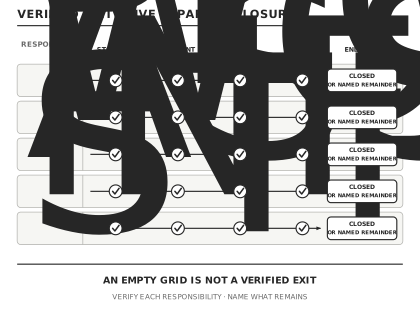
Stop new commitments, account for open work and separate assets by ownership, purpose and consequence. Preserve the capabilities needed to observe, move, receive and close. Treat decommissioning as an authorised, announced and exposed operation whose results still require collection.
Close Shared Locations, Profiles, Access Lists, Roles and guest paths according to their last valid purpose. Verify people, work, assets, information and the Structure separately. Name what remains instead of calling absence of evidence a clean exit.
The decision at the start arrived before crisis and therefore preserved control. That boundary completes Explorer’s teaching about maintained Home. Chapter 16 returns to the pilot’s second night and asks what capability remains when the next pressure is no longer ordinary degradation but deliberate action by someone else.