The Shared Map looks complete when the early shift leaves Home.
One branch leads towards a route used for supply. Another ends at a System scanned during the return. Connection labels, Locations and short notes show where pilots travelled and what they observed. The map is not elegant, but it carried real movement and brought everyone back.
Hours later, a pilot prepares to move important capability along the supply branch. The same colours remain on the screen. The same lines join the same Systems. The drawing does not announce that time has passed.
One note contains the difference. The first Connection was observed near the beginning of the earlier shift, and nobody has confirmed the remote side since the route was last used. Farther along the branch, one entry came from a spoken report rather than direct Observation. The proposed movement does not inherit the certainty that carried the return.
The map has not become false all at once. It has become a mixture of history, current evidence and unanswered questions.
Chapter 5 separated the Baseline into dated layers. The Chain is the layer most likely to resemble a stable object while changing outside the record. To maintain it is not to keep every branch drawn. It is to keep the meaning of every useful branch honest enough for the decision it is asked to carry.
Maps Grow Stale
A Shared Map is a publication about the Chain, not the Chain itself.
The distinction can disappear during routine travel. A pilot observes a Connection, adds both sides to the record and moves through it. Another pilot uses the same branch soon afterwards. Because the publication and the environment still agree, the route begins to feel like a corridor built into Home.
Its apparent stability comes from successful use, not permanence.
Every line on the map rests on an Observation. A pilot saw one side of a Connection at a particular time, under a particular state, and associated it with another side through travel or reliable handover. The map compresses those events into a shape that is easier to use. Compression is necessary, but it can hide the age and limits of the evidence beneath it.
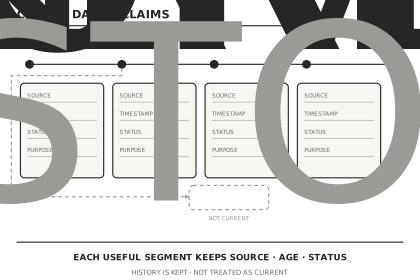
A good Chain record therefore carries more than topology. For a branch that matters, it preserves the Connection, the direction in which it was observed, the Source, the Timestamp and any visible state that changes interpretation. It also says why the observation was considered sufficient. A line confirmed for a scout is not silently promoted into a transport route.
The opening branch contains all the necessary Systems. Its weakness lies in the claims joining them. The first Connection has an old direct Observation. The next is supported by Reported information. The remote side has not been seen during the present shift. Drawing those links in one colour would make three different confidence states look identical.
Freshness belongs to each claim, not to the map as a whole. A pilot can update the Home side without confirming what lies beyond it. A successful journey can confirm the direction travelled while leaving a return condition unobserved. A new Signature account in one System does not refresh a branch two jumps away.
This prevents a familiar maintenance error: treating any activity on the map as evidence that the map is current. Adding a newly found Connection proves nothing about an older route. Removing a dead note does not validate the lines beside it. A busy publication can still carry a stale decision path.
Read the route from the intended movement backwards. Which Connection would stop the purpose if the record were wrong? Which observation supports that Connection? When and from which side was it made? What has happened since then that the record does not show?
The answers may reveal that only one part needs attention. Rebuilding the entire Chain before a short local task is unnecessary when the relevant branch has adequate evidence. Conversely, a beautifully detailed remote branch does not compensate for an unconfirmed first step out of Home.
Maintenance therefore begins with honesty about the map’s form. Lines are claims. Labels are interpretations. Empty space may mean unexplored, irrelevant, expired or simply omitted. A route that still appears on the page must earn its use again whenever age and consequence make the old evidence insufficient.
Time Changes Routes
Time does not affect every route claim in the same way.
Wormhole Connections are temporary, but a Timestamp alone cannot announce the exact moment a particular Connection will cease to be usable. The observable state and the history of the Connection matter. So does the purpose for which the record is being read.
The interface provides bounded information. A Connection can present descriptive lifetime information to the observing pilot. Current terminology also distinguishes Reliable Lifetime from Expired: once the guaranteed period represented by Reliable Lifetime has ended, the Connection is in an Expired state. That name does not mean the Wormhole has already disappeared. It means the earlier guarantee no longer carries the decision and collapse may occur within the remaining variation.
This is exactly the kind of distinction a Shared Map can flatten. A pilot may remember only that a message warned of time. Another may read Expired as a completed event. A third may see the unchanged line and assume the state has not moved. The publication needs the observed wording, time and Source rather than a confident translation into an exact future.
Visible mass-related state creates a similar boundary. A pilot can report the condition presented at Observation. That report supports a decision only within the limits of what was seen and what may have travelled since. The map cannot infer every transit made outside the group’s knowledge.
Time also changes the surroundings of a route. A remote System may gain or lose Signatures. A useful continuation may no longer be present. Confirmation of the first Connection does not confirm the branch beyond it. Even when the physical path remains, its operational meaning can change as access, available ships or the planned load changes.
Avoid solving these uncertainties with one universal freshness rule. A fixed age can create the appearance of discipline while ignoring consequence. It may force needless rescanning of a low-impact branch and still approve an old observation for a movement that cannot tolerate doubt.
Use age as a question instead. Has enough time and unobserved activity passed to change what this claim can support? If the answer matters, obtain a fresh Observation at the depth required by the movement. If confirmation is not available, keep the branch visible as history and lower the decision to Unknown.
The pilot in the opening scene does not need to predict a collapse. The important observation is that an early-shift report no longer justifies the planned movement. Time has changed the confidence of the route before it has proved any change in the route itself.
Purpose Shapes Detail
Not every journey needs the same Chain.
A scout leaving Home to read the nearest System needs to identify the Connection used and recognise the return. The publication also needs enough context to prevent others from confusing it with a different branch. Further detail can follow as the exploration develops.
A working group travelling to a specific site needs a wider account. The relevant continuation, return path and changes that could interrupt the work must remain visible while pilots are occupied. Locations need to be available to the Characters expected to act, not merely to the person who created them.
A movement carrying important capability asks more of the same map. The route must be confirmed to the depth on which the movement depends. Access at the destination matters. The publication must show where the movement can pause, who can update the Chain and what decision ends the attempt if a critical claim becomes Unknown.
These are differences of consequence, not status. The transport pilot is not entitled to a more impressive publication than the scout. Their movement simply exposes more dependencies if the record is wrong.
Purpose should therefore be attached to confirmation. A note such as branch checked says too little. The note leaves unclear whether the pilot identified both sides, inspected only the next System or followed the route to its intended end. The note may be adequate for the task that produced it while remaining unsafe to reuse for another.
A useful confirmation answers four questions. What portion of the branch was observed? From which direction? At what time? For what next action was the result accepted? The answer can be short because the Shared Map already carries the topology. Its role is to expose the boundary hidden by the line.
Detail beyond that boundary is not automatically valuable. Recording every Object encountered along a route can make the publication slower to read and harder to hand over. Only Objects that identify Connections, support access, change movement or preserve return belong in the immediate record. Other observations can remain in working notes until a purpose requires them.
The same principle governs depth. A branch may extend farther than the current decision. The maintainer must not imply that the unseen end is fresh merely because the first part was confirmed. Mark the point at which direct Observation stops. What lies beyond can remain Reported, historical or Unknown.
Consider the difference between a return and a delivery. A pilot returning alone may need the next confirmed Connection and enough context to recognise Home. If that Connection no longer supports the attempt, the pilot can stop, scan and form a new decision before additional capability is committed.
A delivery already gathers several conditions behind the first jump. The carrier, the destination access, the people waiting for the material and the work that follows may all depend on the route. Confirmation must reach the point at which those dependencies can be accepted or released. A route checked only to its first remote System leaves the rest of the delivery decision unanswered.
The map can express this without adding a second map. Give the movement a bounded destination and mark the last directly confirmed segment. Record the fallback that remains available before commitment. If the required depth cannot be observed, reduce or postpone the movement instead of describing the partial route as complete.
This also limits unnecessary detail. The pilot confirming a delivery route does not need to solve every branch encountered along the way. Those branches can remain outside the purpose unless they alter return, offer the agreed fallback or create an immediate ambiguity in the route being used. Depth follows dependency; breadth follows relevance.
When the delivery is complete, its deeper confirmation does not become a permanent standard for all later work. It becomes a dated record of what supported that movement. The next purpose can reuse the evidence only after asking whether time, state and consequence still allow it.
This is especially important when several pilots contribute. One scans the first System. Another follows the continuation. A third receives the result without travelling. Their combined work can produce a sound route, but only if the publication preserves which parts each Source actually observed.
For the opening movement, the group chooses a smaller claim than the supply route is good. The first pilot confirms the Home Connection and its remote side. A second follows the branch to the point needed by the movement. The reported segment remains Reported until one of them sees it directly. Only then can the route be accepted for that purpose.
Purpose has not made the Chain permanent. It has made the required uncertainty visible before pilots and assets are committed to it.
Handover Preserves Doubt
A handover is often judged by how quickly the next pilot can move.
Speed matters, but a smooth sentence can remove the caution that made the earlier observation useful. The route was fine when I came through contains a completed journey, an unstated time, one direction and an undefined idea of fine. When copied into the Shared Map as current fact, it becomes more certain than its Source.
Preserve the uncertainty carried by the report.
If a pilot directly observed a Connection, record it as Observed with the relevant time and direction. If another pilot repeats that information without checking it, the receiving pilot holds Reported information. Repetition does not transform the report into confirmation. A respected Source can improve confidence in what was said, but it cannot add an Observation that did not occur.
This distinction protects the original pilot as well as the next decision. The speaker may have described exactly what they saw. The error enters when the publication drops when I came through and keeps only the route is fine.
A useful handover retains three kinds of incompleteness.
First, it keeps gaps. If nobody inspected the remote end, that end stays Unknown. The blank should not be filled with a likely continuation merely to make the branch look finished.
Second, it keeps disagreement. When two pilots report different visible states, both observations retain their Sources and times until a new check can explain or supersede them. Deleting the inconvenient entry may make the map tidier while destroying evidence of change.
Third, it keeps intention. The next pilot needs to know why an open branch matters. Confirm before supply movement directs attention. Needs scanning could mean anything from curiosity to an immediate dependency.
Ownership completes the handover. An Unknown with no Steward becomes communal background; everyone can see it, and nobody knows whether they should act. A named pilot or role accepts the next Observation, updates the relevant record and reports when the route can or cannot support its purpose.
The owner does not guarantee an answer. They guarantee that the question will not disappear between shifts. If the Connection cannot be found, access is missing or the branch has changed, the owner publishes that boundary rather than extending the old route from memory.
Good handover language remains calm. It presents uncertainty without frightening the next pilot or softening the facts to save time. The result offers evidence, age, purpose and the next unresolved decision.
In the opening scene, the earlier spoken report stays attached to its Source. The pilot preparing the movement can see where direct Observation ends. Distrusting the earlier shift is unnecessary. Confirmation remains necessary for the segment whose old report is now being asked to carry a larger consequence.
Close Dead Branches
Old branches create pressure even after they stop serving a purpose.
They lengthen the map, attract fresh notes and offer familiar shapes to pilots in a hurry. A line that should have become history can be mistaken for a route simply because it remains easier to see than an unresolved alternative.
Closing a branch means ending its authority over current decisions. Closure does not always require proof of the exact moment at which every Connection vanished.
Direct evidence can justify a firm closure. A fresh scan may no longer support the recorded Connection. A pilot may return to the expected Grid and find the Object absent under a known view. The record can state what was observed and when, then move the branch out of the current Chain.
Sometimes the evidence is weaker. The branch has not been checked, its purpose has ended, and its observations are too old for reuse. In that case, mark it as historical or closed to current work without claiming a witnessed collapse. The correct statement is not maintained for present decisions, not proved gone.
This difference matters later. If a similar System or Signature appears, the historical record may help explain what pilots once saw. It must not quietly re-enter the current Chain with its former confidence. A new Connection needs new Observation even when the drawing looks familiar.
Do not keep every dead branch as a monument to effort. Retain enough history to understand handovers, unresolved movement and important changes. Remove or archive the rest according to the group’s publication practice. The Shared Map should make the current decision path easier to see than yesterday’s unused possibilities.
Closure also ends ownership. A Steward responsible for a branch should know when its purpose is complete, transferred or abandoned. Otherwise, maintenance continues by habit and the group spends attention on a route that no longer carries work.
The supply branch in the opening scene receives a clear outcome. If the fresh Observation supports the movement, its relevant segments gain new Sources, times and purpose. A failure to confirm the branch stops the movement and returns the old route to history. A partial check keeps the observed part visible while the rest returns to Unknown.
These outcomes require no pretence of knowledge. The branch is maintained by aligning its published authority with the evidence available now.
Field Principle
The Chain is a set of dated claims about temporary relationships.
Maintain the claim, not merely the line. Preserve direction, Source, Timestamp, visible state and purpose where they carry a decision. Let a report remain Reported until direct Observation confirms what the next action needs. Allow an unused branch to become history before familiarity turns it back into a route.
A Shared Map succeeds when pilots can distinguish three things at a glance: what was observed, what is inherited and what must be checked before movement. It fails when an old shape borrows current certainty from the screen on which it remains drawn.
Useful maintenance can therefore be small. One timely Observation on the load-bearing segment may support the decision better than a broad scan that leaves that segment’s age unclear.
The stale route that opened the chapter can be handled without prediction. Its old evidence is preserved. Its critical segment is assigned for confirmation. The planned movement waits only where consequence meets Unknown.
Maintaining the route answers where the group can move. Movement knowledge cannot answer who can use the Structure at the end, who can see the required Locations or who holds the authority to change either condition.
Chapter 7 separates access from ownership.