A Site appeared in the Probe Scanner, resolved well enough to be entered.
That fact exerted a quiet pressure. The work of locating it was complete, the ship was ready, and the route towards it was known. The next action seemed to have been selected by the result itself: warp, enter, begin.
The pilot waited.
Nothing in the scan result explained why the Site should be used now. It did not name the capability the group meant to restore, the question it meant to answer or the material it could store. It said nothing about the return branch, the person watching it or the Observation that should end the attempt. The result had revealed an opportunity. It had not created an operation.
This pause separates finding from choosing. Exploration, harvesting and other resource work differ in their ships, tools, visible changes and specialised knowledge. They should not be flattened into one universal checklist. They can, however, share an operational movement. Purpose and location come first. Preparation leads to observation, action and re-evaluation. Stopping is followed by return, storage and report.
The movement is longer than the activity on the Grid because the exposure is longer. A Site is not complete when a module stops. The task remains open while the result is in transit, the storage destination is unresolved or the shared record still describes the state from before the operation.
Choose the Purpose
Purpose should fit in one sentence.
“We are going out to see what is there” sounds exploratory, but it leaves the end undefined. Seeing one Grid, resolving one signature and surveying an entire branch could all satisfy it. “We are going to gather resources” is equally elastic. Every additional cycle can claim to serve the same instruction.
A workable purpose names the change the group wants to produce. It might seek enough material to restore a particular reserve, an answer about whether a Site can support a later decision, or a sample that allows a dependency to be tested. The sentence need not include a quantity when no useful quantity is known. It must make completion recognisable.
Purpose comes before selection because selection has momentum. A visible Site, a familiar activity or a waiting ship can make available work feel necessary. Work then begins with the object, and the group invents the reason afterwards. That reversal hides whether the result can be used. Material without a destination, information without a question and output without an owner can all increase exposure while looking like progress.
The purpose also determines the acceptable footprint. If an essential reserve must be restored soon, a modest operation with a short return may serve better than a richer possibility behind several ageing Connections. If the aim is to understand an unfamiliar Site, the operation may prioritise observation and a clean release over cargo. For a training purpose, preserving a readable sequence may matter more than speed. The same opportunity can be suitable for one purpose and unsuitable for another without changing its intrinsic properties.
Before the pilot enters the Site, four consequences follow from the sentence. What result counts as enough? Where will that result go? Which capability may be committed to obtain it? What evidence would make this particular attempt no longer serve the purpose?
The last question protects the first. Suppose the operation exists to restore a replacement reserve. A changing route may make the next load more likely to remain beyond Home than to reach that reserve. Continuing can still increase gross material while moving away from the named outcome. The stop is not a rejection of value. It is loyalty to the purpose.
Different people can propose different purposes. They should resolve the difference before ships commit. One pilot may view the Site as an opportunity to learn; another may expect a production input; a third may assume the task continues while the Site exists. If these expectations remain implicit, each participant will read the same progress and stopping point differently.
The sentence makes the operation discussable: “Return with the material needed for the named replacement, using the current branch only while its observation condition holds.” It states no promise of yield and no universal method. It does say why the field is about to change.
Read the Site
Location begins with the information EVE actually provides.
The Sensor Overlay gives a view of exploration content around the ship. The Probe Scanner separates Cosmic Anomalies, which do not require probes to locate, from Cosmic Signatures, which must be resolved with Core Scanner Probes. That distinction describes how an opportunity becomes reachable. It leaves the group’s readiness to use that opportunity unanswered.
A scan result should therefore be read at two levels. One level is the observed object: its Source, current scan state, location and the time at which those facts were established. The other is the surrounding operation: the route to the Grid, the work the group intends to perform, the tools that work requires and the result it expects to remove.
Only the first level is complete for the opening pilot. The signature is resolved. The Site can be entered. Before turning that result into work, the pilot compares it with the purpose and the current Baseline. Is this the object the group meant to find? Has the system or Chain changed since the route was prepared? Does another operation already depend on the same observer, ship, storage or Connection?
Reading the Site does not require pretending that all its events are known. Specialised activities may contain triggers, hazards or mechanics that this field manual does not teach. If success depends on such knowledge, the group must obtain it from a current specialised Source before treating the task as prepared. Ignorance cannot be repaired by a generic instruction to “be careful.” It should be named as an Unknown with an owner or as a reason not to begin.
The Site also has a visible state that can change through use. Objects may be consumed, containers may be opened, ships may move and capacity may fill. Decide which changes matter for the next action. A harvesting task may care about remaining usable material and available cargo space. An exploratory task may care about which observations have already answered the question. A survey may care less about removal than about whether the recorded state remains attributable to this visit.
This is where one reasoning framework must not become one checklist. “Cargo space remaining” may be central to one task and meaningless to another. “The question has been answered” can end an exploratory visit even when the Grid still offers activity. The shared form is not a list of Site facts. Instead, it connects purpose, visible state and next commitment.
Record only what will survive use. A name copied without a timestamp cannot tell the next pilot when the Site was known. A result without its Source cannot be distinguished from expectation. A claim that the Site is “clear” may hide which question was actually answered. Precise, bounded observations make later work smaller. Vague confidence makes it repeat the discovery.
Once the Site is readable, the pilot can decide whether it is the place for this operation. Availability has finally become relevance, but work has not yet begun.
Prepare the Exit
The exit should be prepared while leaving is still easy.
This means more than saving a location. Preparation requires a current return path, an owner for its observation, a destination for the result and a release path for every committed ship. The plan identifies which action can be stopped cleanly and which step creates a dependency that must be completed. It also needs a point after which no new work begins even if the current action can still be finished.
The return path is a dated claim about the Chain. Its Wormhole Connections are short-lived and subject to both per-transit and total mass limits. Their broad signals help describe current condition but do not reserve the Connection. Preparation therefore joins route use with route observation. A pilot is named to keep the relevant branch current, and the operation states what missing or changed evidence will pause it.
Next comes the ship. The working hull must be able to release from the Grid under the conditions the operation accepts. That question is specific to the activity and cannot be answered by a generic fit in this chapter. It includes the tools needed to perform the task, but it also includes capacity, the means to return the result and the effect of committing this hull on local reserve. Activity-specific details belong to an up-to-date Source and an explicit preparation check whenever the operation requires them.
The result needs a destination before it exists. “Home” is not yet a storage plan. Which personal or Corporation location will receive it? Who can deposit it, who must use it, and can the recipient see and take it afterwards? If the purpose is information, which shared record receives the bounded Observation? If it is material, does the destination create an unmanaged concentration or mix purpose-critical stock with expendable output?
People complete the preparation. One person decides whether the purpose is still being served. The observer owns changes outside the immediate work. The return owner keeps the path and destination readable. A small operation may assign all three functions in a small operation, but the plan should then become smaller enough for that combination to be credible. A title does not create attention.
Preparation also names the partial result. When work stops after the first action, is there something worth returning, an Observation worth keeping or a state that must be reported? A task that only becomes useful after many irreversible steps may need stronger conditions than one that produces a clean partial result. Recognising that difference prevents the sunk work from becoming an argument for ignoring later evidence.
More than a warpable result now exists for the opening pilot. The Site serves a named need. A recent Observation and an owner support the return branch. The result has a destination. The stop conditions are visible to everyone involved. Entering the Grid is no longer the next action suggested by the scanner. Entry is now a deliberate commitment made by the operation.
Harvest Under Change
Work begins, and the field refuses to hold still.
The pilot enters the Site, reaches the intended position and starts the first reversible action. The task now produces its own stream of information: current progress, space aboard, ship state and remaining work. At the same time, the system and Chain continue to change. The operation must observe both streams without treating either as the whole picture.
Re-evaluation should occur at decision points rather than as a continuous feeling. Before another cycle, another container, another transit or another ship is committed, compare the visible state with the prepared conditions. Has the purpose changed? Is the return Observation still acceptable? Does the next step increase concentration beyond the storage plan? Does the operation still have the people and reserve capability it named?
The interval depends on the work. This book does not set a universal timer. Instead, the operation selects moments when commitment can still be withheld. Checking after an irreversible step may record what was lost, but it cannot restore the choice that existed before it.
Change must remain bounded by evidence. Treat a new signature as a new signature, not proof of an actor. A missing observer is a lapse in observation ownership, not proof that the route has failed. A changed Connection signal is the current signal, not a precise prediction of collapse. Each fact can meet a stop condition without being embellished into a story.
This disciplined reading keeps two opposite impulses in check. Momentum says that work has been successful so far and should continue. Alarm says that any change invalidates the entire operation. Evidence asks a narrower question: does this change cross a boundary that was connected to the purpose? If not, record it and continue within the plan. If it does, perform the prepared action before debating a larger explanation.
Progress can change the boundary as well. A cargo hold that was nearly empty on entry now carries a result. More ships may have joined. The same Connection has carried additional transits. The Site may have less remaining value relative to the effort needed to release another load. Even if the external field is unchanged, the operation’s own footprint has grown.
Successful cycles therefore do not prove that the next cycle is wise. They are evidence that previous commitments produced a result under previous conditions. Continuing depends on the present comparison.
Work can remain calm inside this structure. Pilots do not need to narrate every minor state. At the chosen decision points, the task owner needs clear changes, the observer needs ownership of relevant Unknowns, and everyone needs to know when the operation has shifted from work to release. The framework is valuable precisely because it reduces argument while attention is narrow.
Store Before Greed
Material aboard a returning ship is not yet restored capability.
It is mobile concentration. Until it reaches the intended location and can be used by the intended person, it remains part of the operation’s exposure. The phrase “we got the load” can therefore arrive too early. The group has obtained something, but it has not necessarily completed the purpose.
The destination prepared before departure now limits the temptation to keep working. If the destination can receive one useful load cleanly, filling a second ship without deciding where its contents belong does not double success. It adds a storage question while route and attention remain committed. Store a usable result before expanding the footprint merely because the Site still permits activity.
Storage is not a neutral final square. Personal ownership and Corporation ownership create different access paths. A Character able to deposit may not be the person able to retrieve, install or distribute later. A container can make arrangement clearer while its permissions make the contents less usable. A Structure can hold the material while the Service intended to transform it is unavailable. Chapter 12 will examine these dependencies closely. At this stage, the operation only needs to prove that its result reaches the chosen path instead of disappearing into “somewhere at Home.”
Information needs storage too. A Site Observation should enter the shared record with its Source and time. Changes to the Chain, use of a Connection or resolution of an Unknown must reach the relevant record. It must no longer present the earlier state as current. A personal memory of the route does not complete a shared operation.
The word greed is useful here even when no ISK value is discussed. Greed is the desire to keep the visible opportunity open after the purpose is already met. It may seek more material, more complete knowledge or more efficient use of the trip. The impulse is understandable. Preparation was costly, the work is running, and release feels like giving up the remaining possibility.
But a purpose that can never outrank opportunity is not a purpose. Once the named result is stored and the next load would create a new destination, exposure or time condition, the current operation has reached its end. Another operation can be proposed immediately. It should begin with its own sentence, current Observations and stop conditions rather than inheriting permission from the previous success.
The first useful result returns. It reaches the intended location, and the person responsible confirms that the purpose can use it. This small act changes the decision. Continuing is no longer required to rescue value already gathered. The next step can be chosen without the hold arguing on behalf of the Site.
Stop on Evidence
The stop condition belongs to the plan; the stop decision belongs to the present field.
During the operation, one of the prepared observations will eventually change. The purpose may be satisfied. The route may age beyond the accepted condition. A new Unknown may remain unowned. Storage may reach its managed limit. A pilot or reserve ship may cease to be available. Each fact may remain undramatic. It must be true, attributable and connected to the agreed action.
Evidence has a Source and a time. “The Chain feels old” cannot establish which branch affects the return. “Someone said there was a change” cannot show whether the report applies to the current Grid. “We should probably stop soon” does not identify the boundary. The operation needs the smallest statement that can support action: what was observed, where it came from, when it was observed, which condition it meets and who owns the response.
Acting on that statement is not panic. The action completes a decision made when attention was wider. Once the condition is met, the task owner announces that no new commitment begins. Pilots finish only the reversible steps defined by the plan, release their ships and follow the return path while its current observations still support it. If the route itself is the changed condition, they use the prepared fallback rather than improvising a guarantee.
Return is followed by storage. Storage is followed by reporting. The report does not need to celebrate or condemn the attempt. It records whether the purpose was met, what returned, where the result now sits, which observations changed, what remains Unknown and who owns the next check. An incomplete operation can still produce a valuable report if it makes the next decision smaller.
The report must distinguish the Site from the operation. A Site may remain available after the group stops. That does not mean the stop was premature. The operation ended because its own purpose or boundary was reached. Conversely, a Site disappearing does not automatically complete the work; ships, material and records may still need to return.
After closure, release the temporary roles. A finished purpose no longer needs its task owner. The route observer either closes the relevant handover or returns it to normal Chain stewardship. Ships are unloaded and become available or are named as needing replacement or care. This restores capacity that a simple “done” message leaves ambiguous.
At the end of the operation, the pilot can look back at a complete movement. The scanner found a Site. Purpose selected it. Preparation made entry reasonable. Observation shaped each next commitment. Evidence ended the work. Return, storage and report released what the operation had bound.
The visible activity occupied only the middle.
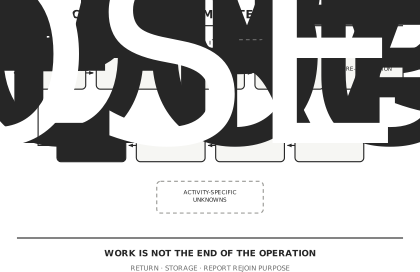
Field Principle
A resource operation begins before the first action on its Grid and ends after the last result leaves it.
Begin with purpose and location. Continue through preparation, observation, work and re-evaluation. Then stop, return, store and report. Keep this order while allowing each activity to define its own tools, specialised knowledge, visible changes and reversible steps. Never use a generic framework to conceal an activity-specific Unknown.
The Site in the opening scene never told the pilot what to do. It supplied an observed possibility. The operation became controlled only when the group connected that possibility to a need, a route, a destination and a stop. Its success was not the number of actions completed. It was the creation of a usable result without losing sight of the surrounding commitments.
That result is now at Home. Before it can restore anything, however, value must often cross more of the Chain than one working ship can carry at once. Chapter 11 follows that movement and asks how much consequence should travel together.