The cargo was ready before the route was.
Containers had been arranged inside the Structure and a pilot had volunteered to move them. Nothing was missing from the inventory. The load could fit aboard the available ship, and the first Connection still showed in the Chain.
For a moment, the task looked like a simple conversion: items in one hangar would become items in another.
Then the route record was opened. One Connection had carried several working ships since its last mass Observation. Another was no longer within the period the group had agreed to treat as reliably open. The destination remained reachable according to the map, but that statement joined observations of different ages and purposes. The cargo was ready. Its recovery conditions were not.
Movement exposes value differently from work. The Site is no longer holding attention, yet the result has become concentrated aboard a ship and dependent on every Connection between its current and intended locations. The pilot must not only ask whether the ship can pass. Movement therefore requires a decision about which consequence should pass together, what the transits consume for others and what counts as a completed arrival.
Value Changes Movement
Cargo acquires meaning from what waits for it.
An inexpensive item can be the only local replacement for a capability the group expects to use. A costly item can be surplus with no immediate purpose. Material may be ordinary in the market and still be difficult to replace through the current Chain. A Blueprint, tool or component may unlock work far beyond its volume. Information can have no cargo volume at all while determining where the movement should end.
Market value matters when loss must be absorbed, but it is not the whole consequence. Before loading, describe the cargo through four questions. What capability does it restore or enable? How soon is that capability needed? What other copy or substitute remains on each side of the route? What later movement becomes necessary if this one does not arrive?
These questions change the shape of the load. Suppose the Structure at Home lacks a replacement item while two copies sit outside. Moving both together may appear efficient. It also places the entire replacement set in one ship and one route attempt. Moving one first restores reserve at Home; the second can follow under a later observation. The total amount transported is unchanged, but the maximum consequence exposed at one time is smaller.
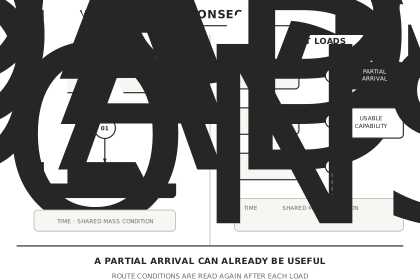
The reverse can also be true. Splitting a set that is useful only when complete may create several transits without creating any usable partial result. The first arrival would occupy storage but restore no function. Every movement after it would still carry the consequence of completing the set. Dividing cargo is therefore not automatically prudent. The unit to split is operational consequence, not merely volume.
Name that consequence in the movement purpose. “Move supplies” gives no basis for deciding what goes first. “Restore one usable replacement at Home while keeping another outside the route” identifies an order and a stopping point. “Move the complete input set for the approved job” explains why a partial load may not justify a separate transit.
Ownership adds another meaning. Personal material moved into a Corporation location may become available through a different access path. Corporation material moved into a personal hangar may cease to be reachable by the people expected to use it. The ship can arrive precisely where instructed and still fail the purpose because the destination was described as a place rather than usable access.
Value changes movement by changing what must remain recoverable. A low-volume item that prevents future work may justify priority. A high-price item with no current purpose may justify delay. No universal cargo limit appears here because groups, routes and replacement states differ. The method asks for the largest consequence the group is willing to place behind the same unresolved event.
That comparison benefits from a manifest written in terms of use. Separate the items that restore a named capability from those that replenish ordinary stock and those that have no current destination. The categories do not assign a permanent rank. They reveal why each item is travelling on this route today. An object can move from optional to essential when the last local replacement is consumed, or from urgent to ordinary when another shipment arrives first.
The manifest should also name dependencies between entries. A tool that is useless without its matching input should not be treated as a complete partial result. A replacement hull without the items required for its intended function may restore less capability than the inventory name suggests. Conversely, a small missing component can be the only part worth moving now if everything else already waits at Home. Reading these relationships prevents volume and price from disguising the real unit of value.
Mass Is Shared
A Wormhole Connection has more than one mass boundary.
There is a maximum mass that can pass in an individual transit, and there is a larger total mass limit across the life of the Connection. These are distinct. A ship being able to make one transit does not mean the Connection can carry an unlimited sequence of comparable transits. The passage of earlier ships is part of the condition later pilots inherit.
The official information provides broad mass signals rather than an exact shared ledger. The operation should not turn those signals into precision they do not contain. A mass Observation records what was visible, when it was visible and which known movements followed. It cannot prove that no unobserved transit occurred.
Mass therefore becomes a shared consequence. The hauler in the opening scene is not the only user of the Connection. Scanners may need to return, working ships may still be outside, and a later operation may depend on the same branch. Every transit consumes part of a changing path whose remaining capacity is not owned by the pilot who happens to use it next.
A movement record can preserve this shared context without pretending to know an exact remainder. It links the last observed mass signal to the known transits that followed and lists the recoveries still expected. When a pilot cannot account for traffic, the record says so. That Unknown may change which cargo the group commits next, even though it cannot prove how much capacity remains.
Shared does not mean that movement must wait for universal agreement. Relevant commitments must instead be visible together. Which ships remain beyond the Connection? Which movement restores an essential capability? What known transits have occurred since the last mass signal? Who owns the updated Observation after this crossing?
The difference between individual and total mass also shapes the return plan. A ship that can pass out still needs a supported transit back if the operation expects it to return. Cargo moved one way may be accompanied by an empty or different ship later. Counting only the loaded crossing hides half the intended movement. The plan should describe the complete sequence it asks the Connection to carry, without claiming an exact remainder that has not been observed.
This section does not teach deliberate Connection collapse. That use belongs to a different operational purpose and a later level of doctrine. Here, mass is read as a condition of ordinary movement. When the signal changes or known traffic makes the original sequence doubtful, the group stops adding value and restores observation. No collapse calculation is improvised from incomplete evidence.
Mass consequence can be reduced in several ways without setting a universal ship or cargo rule. Fewer transits may preserve more shared capacity. A smaller initial consequence may restore a critical reserve before optional material moves. Waiting for a new route may remove pressure from a Connection carrying other commitments. Declining the movement may be correct when the purpose is weaker than the recovery it could disturb.
The first question at the Connection is therefore not merely “Can this ship jump?” It is “What planned movements and remaining commitments does this jump change?”
Time Is Shared
Connections age while cargo waits and while it moves.
The current Wormhole information uses Reliable Lifetime for the earliest point at which the Connection may collapse. Once that guaranteed period has ended, Expired can indicate that collapse may occur at any moment. Neither term supplies a promise that the route will remain for the full plan. The useful fact is bounded: the Connection has a current lifetime signal, and the movement consumes time within it.
Time begins before undock. Loading, assigning a pilot, confirming access and checking the Chain all occur while Connections age. A route that supported the proposal may no longer support the complete movement when the ship is ready. The observation used to approve the task must therefore be compared with the moment commitment actually begins.
Time is shared because other plans also depend on the same period. A scanner may intend to return later. A working group may be preparing its final load. A pilot outside Home may not yet know that the movement will change how the group reads the branch. An ageing Connection is not one pilot’s timer. The period is a common condition attached to several possible recoveries.
An exact deadline invented by the group does not make the underlying lifetime exact. Internal boundaries remain useful if they are described honestly. The group might refuse new value movement after a particular observation condition or require a fresh route check before the next load. That rule governs its own commitment. The rule cannot predict the Connection.
The complete movement needs time on both sides of each transit. A pilot must approach, cross, orient, continue and perhaps repeat the sequence. At the destination, access must work, and the cargo must be received. A required ship return means unloading does not end route dependence. Planning only the moment of passage hides the time spent while value remains between useful states.
Chain depth multiplies these comparisons. Each Connection has its own Source, Observation and age. A route described as “current” can still contain one branch whose evidence no longer supports the cargo consequence. The weakest claim for the purpose matters more than the average freshness of the map.
The hauler in the opening scene encounters exactly this problem. Every Connection is drawn, yet one lifetime Observation has passed the group’s working boundary. The route is not declared closed, and no danger is invented. The movement simply lacks the evidence required to commit this value beyond that branch. Cargo remains stored while a named pilot restores the Observation or identifies another route.
Waiting can be an active transport decision. It preserves value, avoids adding mass consequence and allows the route to be chosen from current evidence. Movement is not successful merely because it begins quickly.
Split the Exposure
Once the route is readable, decide what should be exposed together.
The answer may divide cargo, time, ships, destinations or responsibility. Division should not occur merely for the appearance of caution. Each part needs a useful purpose, a complete movement and a stop condition of its own.
Begin with replacement. If losing or delaying one load would remove every copy of a needed capability from one side, the concentration is high. Move enough to restore a usable reserve without automatically placing the entire reserve aboard. Where the cargo forms an inseparable set, recognise that the set is the unit of consequence and consider whether the current route should carry it at all.
Next consider sequence. The first load can contain what makes later delay tolerable: a usable replacement, a required tool or the part that releases a blocked function. Optional bulk can follow under a fresh comparison. This order turns early arrival into reduced exposure rather than simply a smaller fraction of the manifest.
Time can be split by closing one movement before approving the next. The pilot returns or the receiving side confirms storage; the Chain record absorbs the known transit; remaining cargo is reconsidered against the new mass and lifetime signals. A successful first crossing does not grant the second one permission. It changes the evidence on which the second must be decided.
Destinations can reduce concentration when they correspond to real use. Keeping every replacement in one Structure may simplify counting while making one asset outcome more consequential. Scattering items without ownership or an inventory record creates a different failure. Distribution is useful when each location has a named purpose, access path and person responsible for its state.
Responsibility should not be split into fragments nobody can close. One person owns the movement purpose. Another may own the route Observation, and a receiver may confirm arrival and access. Their handovers must be explicit. The pilot should not discover after crossing that the receiver assumed somebody else could accept Corporation cargo.
Failure should be split only when the result is genuinely independent. Two ships following the same stale route at nearly the same time may divide cargo without dividing the route consequence. Sending them to destinations governed by the same unavailable access can duplicate the same failure. By contrast, one usable replacement delivered and confirmed before the second departure creates a real boundary: later delay no longer removes the capability already restored.
The group also sets a maximum concurrent consequence in its own language. The only two copies of a capability may travel separately. Another load may wait until the first becomes usable. Optional material may remain stored while people are beyond the same ageing branch. These are local decisions, not universal numbers. Their strength comes from the consequence they name.
Splitting exposure often feels slower because it inserts moments when the group can stop. Those moments are the purpose. Efficiency that removes every clean stopping point transfers the decision to the first failure.
Arrival Is Incomplete
The hauler docks. The cargo remains aboard.
On the map, the movement is over. In operational terms, the value has reached a new container but not necessarily a usable state. Arrival must be followed by receipt, placement, access confirmation and a record of what the route carried.
Receipt answers whether the intended destination exists as planned. Can the pilot place the cargo there? Is the receiving Character or Corporation context correct? Does the person responsible for the next use have the required access? A movement into the wrong ownership path can transform accessible value into a permission problem without changing its physical location.
Placement connects cargo to purpose. A replacement belongs where it can replace. A manufacturing input belongs with the approved job path, not in an undifferentiated pile that somebody will identify later. Material held for a future exit should not be mixed with stock expected to remain. The more clearly the destination states its function, the less knowledge must be reconstructed under pressure.
The inventory record should now change in the same terms as the manifest. It notes what arrived, the ownership context, the location, the intended use and the person responsible for the next action. If the movement left another location below its accepted reserve, that consequence remains visible too. Transport has changed both ends, and recording only the destination would make the source appear more capable than it has become.
Confirmation closes the receiver’s handover. “Docked” reports the ship. “Received in the named location, visible to the named user” reports the result. If access fails, the cargo is not silently declared complete. The receiver records the Unknown, names who can resolve it and prevents the next load from repeating the same path until the destination is usable.
The Chain record also changes. Known transits belong with the mass Observation that preceded them. The time of the movement matters to later lifetime decisions. If the pilot returned by a different branch, the route actually used must appear in the Shared Map. An earlier claim that aged out must not remain presented as the current plan.
Finally, release the ship and people. If the hauler is meant to return, the movement remains open until its recovery path is closed or handed over. If it stays at the destination, its capability has moved with the cargo and the Home inventory should not continue to count it as local reserve. The route observer confirms who now owns the relevant branch. The receiver confirms what remains to be moved.
Only then can the group compare result with purpose. It has restored the named capability, preserved a replacement on the other side and recorded the Connection use. Optional cargo remains where it began. That remainder is not a failure. The remainder becomes a later decision with less consequence attached to it.
The opening cargo was ready before the route. By refusing to confuse readiness with permission, the group allowed current evidence to choose the movement. By refusing to confuse docking with completion, it turned transported items into available capability.
Field Principle
Move consequence, not just cargo.
Describe value by the capability it restores, its replacement state and the access it needs at the destination. Keep per-transit mass distinct from the Connection’s shared total mass condition. Treat Reliable Lifetime as a bounded signal, not an exact reservation for the return.
Limit what can be lost or delayed behind the same event. Split exposure when a partial arrival becomes useful; keep an inseparable set together only when the current route justifies the whole consequence. Reconsider each new load after the preceding movement has changed mass, time and distribution.
The cargo in the opening scene did not become less valuable while it waited. Waiting protected the purpose until the route could support it. After movement, receipt and access made the value real for Home.
Deliberate delay preserved the choice that premature efficiency would have spent.
Value now needs somewhere to remain and some way to become replacement. Chapter 12 follows it into storage, ownership and Industry, where an item can be inside the Structure and still be unavailable to the work that depends on it.