The Pathfinder returns to the Wormhole and opens its information window. The connection has not moved. Nothing on the Grid announces a crisis. Yet the door is already less certain than it was when the ship first arrived.
Time has passed. Other ships may have crossed. The Wormhole may still accept the next transit, or the next transit may be the one that ends it. Its calm appearance does not reveal which possibility is nearer.
The window does not remove that uncertainty. It gives the pilot something more useful: a small set of limits around it.
There is a clue about the kind of space on the far side. There is a statement about how long the connection can still be relied upon. There is an indication of how much of its ability to carry mass remains. Together, these do not predict the future. They describe the operating envelope of the present door.
That distinction matters. A prediction asks, Will it survive my plan? The Wormhole Information window cannot make that promise. An operating envelope asks, What does the connection still permit me to believe? That question can be answered well enough to shape a decision.
Understanding a Wormhole begins there: not with memorising every type, but with learning what the door reports, what it withholds and how quickly an accurate observation becomes old.
Read the Door
A Pathfinder reads a Wormhole before treating it as a route.
The information is compact, but it answers several different questions. They should not be allowed to collapse into a single impression of good or bad. A connection may point toward useful space and still be too uncertain for a long operation. It may have a comfortable Reliable Lifetime while its mass condition is already poor. It may look suitable for a scout and be unusable by the ship expected to follow.
Read the door in parts:
- What kind of destination does the information suggest?
- What does
Reliable Lifetimesay now? - What does the mass indication say now?
- Can the intended ship pass through at all?
- Which parts are Observations, and which came from a Report?
The repeated word is now. The window describes the Wormhole at the moment it is inspected. The result may survive in a Shared Map, but the map cannot preserve the condition itself. Time continues. Traffic continues. The record and the door begin to separate as soon as the observation is made.
A Pathfinder therefore does not merely copy a message. The pilot reads it in relation to an action. A scout crossing once, a Fleet moving through in both directions and a ship waiting for a later return do not ask the same thing of the connection. The words in the window may be identical; the consequences of being wrong are not.
Rough, Not Exact
The Wormhole Information window provides rough data. That is not a flaw in the instrument. The boundary lies in what the client is offering.
Its destination clue describes the nature of the system beyond the door, not an exact Solar System name. Its lifetime and mass entries describe condition, not a hidden counter made visible. The pilot receives categories and warnings, not a timetable and a ledger.
That leaves a dangerous temptation: to turn a qualitative message into a number it never contained. A fresh-looking statement becomes an assumed number of hours. A stable mass statement becomes an assumed number of ships. A recent Report becomes a present fact. Each conversion makes planning feel cleaner by removing uncertainty on paper. None makes the Wormhole more certain in space.
The disciplined reading is narrower. Record the words that were actually shown. Record when and where they were observed. If a decision depends on more than those words support, gather a new Observation or reduce the commitment.
An approximate instrument can still support precise behaviour. It simply requires precision about the limits of the evidence.
Type Sets Limits
Wormholes are not interchangeable doors. Their type matters because the limits are not the same for every connection.
The maximum mass permitted in one jump varies by Wormhole type. So does the higher total mass the connection can carry before collapsing. A type is therefore not decorative nomenclature. It is part of the rule set under which that connection exists.
For the Pathfinder, the first lesson is not to memorise a catalogue. The pilot must stop borrowing expectations from the last door. A ship that crossed one Wormhole has not proved that it can cross the next. A connection that endured one operation has not established the capacity of another. Familiarity with the phenomenon does not make its limits universal.
Later chapters will separate destination Classes, System Types and Environmental Effects. Here, the important habit is simpler: identify the particular door, read its current condition and attach every conclusion to that connection.
Destination Clues
Before transit, the information window offers the nature of the system to which the Wormhole connects. It narrows the Unknown; it does not name the far side.
That difference is operationally useful. A category can tell a Pathfinder whether a door belongs in the present search, whether a Fleet should wait and whether the next observation is worth the exposure of a crossing. It can also prevent a bad assumption: two Wormholes that suggest the same kind of space do not therefore lead to the same Solar System.
The far side becomes an observed place only after someone reaches it and records what is there. Until then, the destination remains a clue attached to the near-side connection.
This preserves a clean line between inference and observation:
- the information window supports a statement about the destination’s nature;
- a transit supports a statement about the destination actually reached;
- a current Shared Map supports a route only as far as its Observations remain trustworthy.
The clue is valuable because it reduces blind movement. It is limited because it does not perform the movement for the pilot.
Reliable Lifetime
The current Wormhole Information window uses the label Reliable Lifetime.
The word reliable carries the meaning that an older, simpler lifetime label
did not make clear enough.
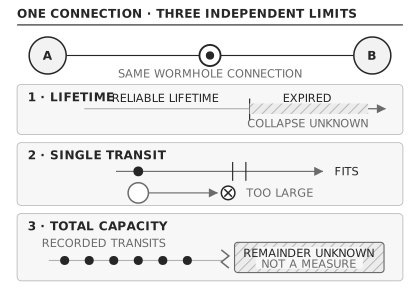
The entry is not a countdown to an exact moment of collapse. Its messages are anchored to the earliest time at which the Wormhole could close, while the actual lifespan contains variance. The field question is therefore not When will it die? It is For how long does the client still describe this door as reliably available?
Once that guaranteed lifespan has ended, the information window can show the
state Expired. At that point the Wormhole could close at any moment. Expired
does not mean that the connection is already gone; a visible Wormhole is still
present. Nor does presence restore a dependable return window. It means the
pilot is looking at a door that has outlived the period the client was willing
to guarantee.
That is a subtle but important condition. A Pathfinder may still be able to
cross an Expired Wormhole. The relevant question is what the plan asks the
door to do afterward. A one-way escape, an immediate look and a delayed Fleet
return place very different demands on the same surviving connection.
Time also continues between observation and use. A lifetime message copied to the Shared Map is not renewed by being read there. The Timestamp belongs to the Observation, not to the Wormhole. If the route matters, inspect it again.
This is the proper use of Reliable Lifetime: not as permission, but as a
boundary on confidence.
Two Mass Limits
Mass constrains a Wormhole in two different ways. Confusing them can make an open connection look usable when it is not.
The first limit applies to a single jump. A Wormhole permits only a limited amount of mass to transit during that jump. If the intended ship exceeds that limit, the connection can remain open and still refuse that ship. This is an admission limit: Can this transit pass through the door?
The second limit belongs to the connection as a whole. A Wormhole can carry a higher total amount of mass across all transits. When that total limit is reached, the Wormhole collapses. This is a capacity limit: How much use can the door sustain before it ends?
The limits answer different questions:
- maximum jumpable mass concerns one attempted transit;
- total mass concerns the accumulated use of the connection.
A small ship may fit through the first limit and still be the final transit before the second is exhausted. A larger ship may be below the remaining total capacity and still exceed what the Wormhole permits in one jump. Open is not a complete description of usable.
The information window does not expose an exact running total. It reports a rough mass condition. That condition is evidence about remaining capacity, not a manifest of every ship that crossed. Unobserved traffic matters because it changes the connection without changing the Pathfinder’s record.
Mass planning and mass control therefore become specialised work. Rolling a connection deliberately requires numbers, ship states, direction and coordination that belong to later doctrine. The Pathfinder needs the foundation first: there are two limits, every transit interacts with them, and the client does not promise an exact remainder.
Every Transit Counts
Crossing a Wormhole is not passive observation. It changes the object being observed.
The ship that goes through contributes mass to the connection’s used total. The time spent scouting, waiting or forming a Fleet advances its age. A second crossing is therefore not made through exactly the same operational condition as the first, even when the information window still uses the same words.
This creates a useful reversal of ordinary travel. In a Stargate network, using a gate does not ordinarily spend the route. At a Wormhole, movement is part of the route’s history. Reconnaissance, transport, rescue and return all draw on the same temporary connection.
The Pathfinder should therefore see traffic as both movement and information. A known transit confirms that the door accepted a particular ship at a particular time. It also means more mass has passed, and more time has elapsed. An unknown transit provides no report at all while still changing the condition.
No single crossing needs to be treated as a crisis. The habit is simply to stop imagining the door as untouched between checks. Observation and use are entangled. The act that answers one question may weaken the condition on which the return depends.
Record the State
A useful Wormhole record preserves enough context for another pilot to judge its age and limits. The record makes no claim to preserve the Wormhole itself.
At minimum, the record should connect four things:
- the particular connection and the side from which it was observed;
- the destination clue reported by the information window;
- the exact
Reliable Lifetimeand mass wording observed; and - the Timestamp of that Observation.
If the information came from another pilot, keep the Source visible. An accurate Report can be operationally valuable, but it is still a Report until someone verifies it. If the condition is checked again, add the new Observation rather than silently moving the old Timestamp forward.
The distinction protects the group from a common failure. A map entry can look current because someone edited it recently even though the Wormhole condition inside it was observed much earlier. Recording the observation time keeps the age attached to the evidence, where it belongs.
The same discipline applies when the state worsens. Do not soften the wording
to preserve an attractive route. If Reliable Lifetime now reads Expired,
record Expired. If the mass indication has changed, replace expectation with
the new Observation. The Shared Map is useful only while it is allowed to
disappoint the plan.
Good records do not eliminate rechecking. They tell the next pilot what needs to be rechecked first.
Field Principle
A Wormhole is a door with limits, not a promise with a destination.
Its information window gives rough but useful evidence: a clue about the far side, a boundary on reliable time and a condition for remaining mass. Its type shapes the limits. Every transit uses the connection, and every minute ages the Observation.
Read what is shown. Preserve when it was shown. Never make the door guarantee more than the client has said.