The scanner returns a ship.
The Pathfinder narrows the angle. The ship remains. The range is reduced, and the result disappears.
Nothing has been located precisely. No pilot has been identified. Yet the system is no longer as quiet as it appeared one scan ago.
Its reach beyond the current Grid makes the Directional Scanner valuable without requiring probes. It becomes dangerous when a clean list is mistaken for continuous coverage or a contact list for a complete tactical picture.
The instrument does not pronounce a system safe. It takes a bounded snapshot from the ship’s position. Pathfinder work begins by knowing the shape of that snapshot.
A Manual Snapshot
A Directional Scan is an active measurement. The returned list belongs to the moment at which the scan refreshed.
Ships continue to move after that moment. A contact can warp, cloak, leave the range or enter it while the old result remains on screen. Probes can be recalled. A new ship can cross the system between two scans.
A result therefore needs time even when the interface does not ask the pilot to write one down. No ships on scan is already ageing as it is spoken.
Repeated scans create a sequence. If the same object appears through several measurements, the Pathfinder can build confidence that it remains within the observed volumes. If it disappears, several explanations remain possible: movement, cloaking, a changed setting, a changed filter or a position outside the next volume.
The scanner reports the difference. The pilot supplies the interpretation.
Treat every refresh as a new Observation rather than an update that silently rewrites the past. The earlier result may explain how the current picture changed.
The Scan Volume
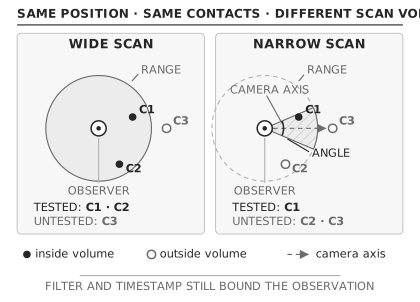
The scanner begins at the ship. Its range sets how far the measurement extends. Its angle sets how much space around the chosen direction is included.
At the widest angle, the volume surrounds the ship and answers a broad presence question. Direction is largely surrendered for coverage. At narrow angles, the volume becomes a cone and the result carries more directional meaning while covering less space.
The cone follows the camera alignment used by the scanner, not the direction the hull happens to face. A ship can be travelling one way while the Directional Scanner examines another.
That geometry explains both the tool’s power and its silence. An object can be close enough but outside the angle. It can lie in the correct direction but beyond the range. Even inside the geometric volume, the filter or the scanner’s detection rules may exclude it.
An empty result therefore means:
No eligible object was returned from this configured volume at this refresh.
Everything after that sentence is interpretation.
Range and Angle
Range and angle trade coverage for discrimination.
A broad, long-range scan is useful when the question is whether detectable ships, probes or other relevant objects exist around the current position. It leaves their direction unknown.
A narrow scan can test a suspected line towards a celestial, Signature area or other point of interest. A positive result gives direction within the width of the cone. It still does not provide coordinates.
Reducing range can bracket a contact. When a ship appears at one setting and disappears at a shorter one, its distance lies beyond the shorter boundary and within the longer boundary at the times measured. The contact may move between those scans, so the bracket is an estimate, not a fixed location.
The present effective range should be read from the current client and ship conditions. Current equipment and fleet effects can modify Directional Scanner range. A remembered universal maximum is therefore a poor foundation for a field report.
Report the range used. The number tells another pilot what the absence actually covered.
Filters Define Results
The scanner does not place every detectable object into every result.
Its selected filter determines which object types are shown. Filters can use Overview presets, and an active Overview view may exclude precisely the object the Pathfinder meant to watch. The scanner uses type membership for this purpose; Overview state rules do not add hidden state knowledge to the scan.
This makes a clean result conditional twice: the object must be detectable, and the chosen filter must allow its type.
A specialised filter can reduce noise during a specific question. A ship-and-probe view can make a new contact easier to notice than a list filled with structures and celestial objects. The same filter is poor evidence for the absence of deployables or other omitted types.
Before trusting silence, name the filter’s purpose. If the question changes, the filter may need to change with it.
The useful habit is not leaving everything visible forever. It is knowing what the present list has been allowed to hide.
Broad Before Narrow
Narrow scans feel precise. Precision without an initial direction can become tunnel vision.
A broad scan first asks what detectable evidence surrounds the ship. Its result can identify contacts worth isolating and prevent attention from settling on one attractive celestial while activity occurs elsewhere.
Narrowing then becomes a reasoned change:
- isolate one contact from several;
- test whether a result lies near a known direction;
- separate overlapping celestial lines; or
- reduce a wide warning into a more useful area.
The order is not a ritual. If the Pathfinder already has a specific report to verify, a narrow question may be appropriate first. What matters is that the pilot understands which space was deliberately excluded.
After narrow work, return to breadth when the operational question becomes general again. A hunter, route or probe set outside the narrow cone has not stopped existing because the current result looks clean.
Coverage and precision are different resources. Spend each on the question it can answer.
Narrow With Purpose
Each narrowing should remove a known ambiguity.
When a ship remains at a smaller angle aimed towards a planet, the direction has become more constrained. If several celestials share that line, the result still cannot establish which one contains the ship. If the contact disappears after a slight camera movement, it may lie near the edge of the earlier cone or may simply have moved.
This is where the Solar System map and visible scan cone help. They let the Pathfinder see the relationship between the ship, the selected direction and candidate locations instead of relying on the apparent centre of the screen.
Do not narrow merely until the number looks impressive. Stop when the result supports the decision.
A Pathfinder checking whether a Wormhole is being watched may need to distinguish the connection’s direction from nearby celestial lines. A pilot deciding whether to remain at a site may only need to know that an unfamiliar ship is somewhere in the surrounding volume.
The appropriate resolution belongs to the consequence, not to the scanner’s smallest available angle.
Distance by Exclusion
No object distance appears in a Directional Scan result. Range changes can still place boundaries around a contact.
Assume a ship is returned at a longer range. The Pathfinder shortens the range, keeps the direction and filter constant, then refreshes. If the ship no longer appears, it was not returned inside the shorter volume at that later moment.
The useful statement is:
The contact was inside the longer scan and outside the shorter scan across these two measurements.
That is stronger than somewhere in system and weaker than a coordinate.
Movement is the principal uncertainty. A fast or warping ship can cross the boundary while the pilot changes settings. Camera drift, angle changes and filter changes add further ambiguity. Change one variable at a time when the distinction matters.
Range bracketing can support a warning, help separate candidate locations or decide whether another observation point is needed. It cannot create a Warp Destination where none exists.
Directional information remains an area of possibility until another tool or known object supplies a usable location.
Read the Result
The result list reports object names and types. No pilot identity, exact distance, coordinates, activity state or intention accompanies a ship.
These omissions matter immediately.
A combat-capable hull is not proof of hostile action. An exploration hull is not proof of harmlessness. A familiar ship name may be deliberate misdirection. A Structure on scan does not reveal its full state merely by appearing.
Context can support Derived conclusions. A ship appears, Combat Scanner Probes soon follow and both persist near the direction of the Pathfinder’s site. That sequence can justify increased concern and a more reversible action. It still does not disclose the pilot’s mind.
Read changes as carefully as objects. A cluster of probes spreading and contracting suggests active Scanning. Wrecks beside ships may indicate recent combat or site activity. A contact vanishing at the same moment a new contact appears may be related, or may be coincidence.
The list provides facts. The sequence provides structure. Neither provides certainty beyond the instrument.
What Stays Hidden
Some objects are outside the Directional Scanner’s detection model.
Cloaked ships do not appear. Combat Recon Ships are also excluded from Directional Scan results. Cosmic Signatures, Cosmic Anomalies, ordinary Bookmarks and normal NPCs are not discovered by this instrument.
Other objects may be detectable in principle but absent from the current result because of range, angle or filter.
These are different kinds of absence. The first comes from the scanner’s rules. The second comes from the configured volume. The third comes from the present display choice.
The Pathfinder does not need to memorise an exhaustive object catalogue before using the tool. The pilot does need to reject the sentence D-Scan is clear, therefore nothing is there.
A clean scan can support action when its blind areas are acceptable for that action. A cloaked scout may continue gathering low-commitment information. An exposed ship may decide that the same Unknowns are too costly.
The instrument’s blind areas do not make every contact equally likely. They set the ceiling on what absence can prove.
Probes Mean Possibility
Core and Combat Scanner Probes can appear on the Directional Scanner when they are detectable within the configured volume.
Their presence is evidence of Scanning. Their absence is not evidence that no one is scanning: the probes may be outside the volume, excluded by the filter or between observed positions.
The probe type changes the range of plausible purposes. Core Scanner Probes are used to resolve Cosmic Signatures. Combat Scanner Probes can also be used to find ships and other eligible targets. Neither result identifies the operator or proves the target.
Treat the sequence as information:
- When did the probes first appear?
- Did their pattern or count change?
- Did a ship appear before or after them?
- Is the Pathfinder at a location another pilot would need to scan?
- Which action becomes difficult to reverse if the probes are relevant?
A good response may be to reduce exposure, change position, warn the group or continue observing. The decision depends on ship, purpose and available exit.
Probes are not a verdict of attack. They are evidence that another set of questions may be moving through the system.
Movement Changes Geometry
The scanner’s origin moves with the ship.
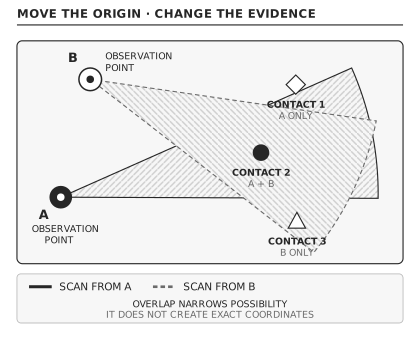
Warping to another point does more than bring new Grids into reach. It changes which parts of the system fall within range and how directions overlap. A contact absent from one position may appear from another without having moved at all.
Camera movement changes the direction of a narrow cone. Ship movement changes its origin. Range and angle change its volume. Filter changes its eligible contents. Time changes the scene.
These variables explain why two pilots can make different, accurate reports from the same system.
Do not settle disagreement by choosing the newer or more confident voice. Compare positions, times and settings. One pilot may be beyond range of the contact. Another may be looking through a filter that includes it. The contact may have moved between scans.
Multiple observation points can create useful coverage, but they do not merge automatically. Shared awareness requires each report to preserve the geometry that produced it.
The system did not contradict itself. The measurements looked through different windows.
Build a Rhythm
Directional Scanning becomes survival work when it continues alongside the task rather than preceding it once.
Begin with a baseline suited to the current position. Refresh when entering a new system, arriving at a new working Grid, changing exposure or receiving a report that alters the question. During an extended task, scan often enough that a new contact can still change the decision.
No universal interval can guarantee this. The appropriate rhythm depends on how quickly the ship can leave, how visible it is, what it risks and which approaches the current volume covers.
Attention also has limits. A pilot absorbed by Scanning can neglect the Grid, the Probe Scanner, Wormhole state or the actual task. The rhythm should move between instruments:
Observe the Grid. Refresh the intended Directional Scan. Compare the result with the baseline. Record or report meaningful change. Return attention to the operation.
The point is not constant clicking. Keep the picture younger than the time needed to act upon it.
Report the Scan
D-Scan clear is usually too small a report.
At minimum, another decision may need the observing position, time, range, angle and filter purpose. A contact report also needs the returned ship or object types and whether the result persisted through another measurement.
Useful wording separates result from conclusion:
14:22, inbound Wormhole: broad scan at displayed maximum range, ship-and-probe filter. One Stratios and eight Combat Scanner Probes returned. Direction not yet narrowed.
No claim joins the Stratios to the probes or assigns hostile intent to either. The report instead gives the group enough evidence to decide what to verify next.
For a negative result:
14:24, same position and settings: no ships or probes returned. Far side of system remains outside range.
This preserves the change without declaring the contact gone from the system.
A Directional Scan becomes shared intelligence only when its geometry and age survive the person who pressed Scan.
Field Principle
Each Directional Scan returns a manual snapshot of eligible objects inside a configured volume. Range, angle, camera direction, filter, position and time all define what that snapshot can mean.
Scan broadly to establish context, narrow to answer a reasoned question and report the settings that bound the result. Absence is evidence about the measurement, never proof that the system is empty.