The fit was tested before departure. Its capacitor was stable enough for the planned work. Its defences had known limits. The Pathfinder understood how quickly it could align and what its weapons could apply.
After transit, the same ship tells a different story.
One defensive layer has grown. Another has weakened. The capacitor behaves differently, and a familiar module no longer produces the expected result. Nothing has been damaged. The system itself is changing the ship.
Environmental Effects are not scenery, and they are not a label to add after the route has been planned. They alter the conditions under which every capsuleer ship in that system performs. A fit that was suitable outside may become stronger in one respect, weaker in another and tactically unfamiliar in both.
Complete matrix memorisation is unnecessary before entry. The pilot does need to recognise the Effect, identify which assumptions it changes and refuse to treat a bonus as a general promise of safety.
The System Acts
Some Wormhole Space systems contain a secondary stellar phenomenon whose Effect modifies ship attributes and modules throughout the system.
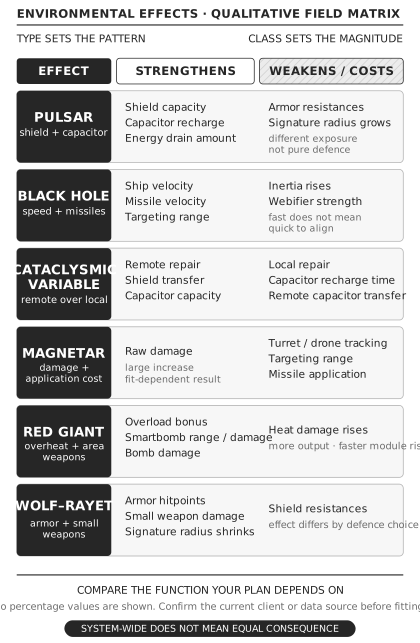
The official Static Data Export identifies six Effect Types: Magnetar, Pulsar, Black Hole, Cataclysmic Variable, Red Giant and Wolf-Rayet. The same Type can appear across different ordinary Wormhole Classes.
The Effect belongs to the system, not to the Wormhole used to enter it. Every current connection into that system leads into the same modified environment. Leaving through any connection ends those system conditions and replaces them with whatever applies on the far side.
This makes the Effect stable context for the visit. Unlike a Directional Scan result, it does not age, but the record still needs a reliable Source. Misidentifying the system or copying an incorrect map entry can apply the wrong assumptions to every ship that follows.
Read the Effect as part of system identity:
System confirmed. Class confirmed. Effect confirmed. Present contacts still Unknown.
The Effect changes performance without disclosing who may exploit that change.
Class Sets Strength
Effect Type and Effect strength are separate pieces of information.
In ordinary C1 to C6 systems, the same Effect grows stronger with the Class. A Pulsar remains a Pulsar, but its modifications do not have the same magnitude in every Class. The official data represents this through an Effect Beacon tied to both the Effect and the Class.
This is why an Effect name alone is incomplete.
Magnetar identifies the direction of the changes: more raw damage alongside poorer application and targeting conditions. The Class determines how far those changes reach. A fit judged from the Effect name without its strength can still be badly misjudged.
Special System Types can require separate checking. Do not force their behaviour into an ordinary C-Class rule merely because the visible Effect name is familiar.
Do not reconstruct exact percentages from memory. Current attributes, current data and a suitable fitting tool can provide the values when a decision requires them. The field skill comes first: recognise which performance axes have moved and test whether the operation depends upon them.
Read the Change
The client can display the active Wormhole Effect among the ship’s current effects. The ship and module attributes then reveal what those conditions mean for the fitted hull.
Begin with dependencies rather than the full attribute list.
If survival depends on shield capacity, inspect shield changes. Where the route depends on a quick align, inspect movement and inertia. A ship relying on local repair needs its local repair performance examined. When the plan expects weapons to apply to small targets, raw damage is only part of the answer.
This approach prevents an Effect from becoming trivia.
A Pathfinder may record:
- the confirmed Effect Type and system Class;
- the Source used to identify them;
- the ship functions materially changed;
- which earlier fit assumptions no longer hold; and
- what must be tested before greater commitment.
The result serves as an operational warning, not as a replacement fitting guide.
C4 Black Hole: movement, inertia and web assumptions changed; present hull not yet evaluated for the route.
That note tells the next pilot what the Effect means before claiming whether the ship is good or bad.
Bonuses Carry Costs
Every Effect creates advantage and disadvantage together.
A bonus may improve the strongest part of a fit while exposing a different weakness. It may help the Pathfinder and any hostile capsuleer using the same environment. It may strengthen a module without improving the decision in which that module is used.
Raw damage does not guarantee good application. More shield capacity does not repair weakened armour resistance. Greater ship velocity does not promise a shorter align when inertia also changes. Stronger remote repair does not help a solo ship whose local repair is reduced.
The word bonus is therefore too small for operational use. Ask:
- which attribute changes;
- which ship function depends upon it;
- what linked penalty moves at the same time;
- who else receives the same opportunity; and
- whether the present plan can still be reversed.
Environmental Effects reward preparation because they make specialised choices more powerful. They punish shorthand because the most visible benefit can hide the condition that actually decides the outcome.
Pulsar
A Pulsar favours shield capacity and capacitor recharge while enlarging ship Signature Radius. It also reduces armour resistances and strengthens Energy Neutralizer and Nosferatu drain amounts.
The immediate attraction is obvious: a shield-focused ship may display a much larger defensive buffer, and capacitor recharge can improve. The larger Signature Radius also makes the ship easier for weapons and sensors to interact with. An armour fit pays a direct resistance cost.
Those changes do not produce one universal winner.
A shield ship can gain endurance while becoming easier to hit. A capacitor plan can improve while hostile capacitor warfare becomes stronger. An armour ship that was comfortable outside the system can enter with a defence that no longer matches the calculation made before transit.
Record the dependency, not merely the theme:
Pulsar present. Shield and capacitor assumptions revised; armour resistance, Signature Radius and capacitor warfare also changed.
The system favours certain preparations; preparation of the ship still belongs to the pilot.
Black Hole
A Black Hole increases ship velocity, missile velocity, missile application through Explosion Velocity and Targeting Range. It also increases inertia and reduces Stasis Webifier strength.
The ship can move faster without becoming more agile.
That distinction changes navigation. Higher maximum velocity may lengthen the distance covered during movement, but increased inertia can slow acceleration, turning and alignment. A route planned around a familiar time to enter Warp may therefore behave differently even while the velocity display looks impressive.
Weaker Webifier strength changes both escape and control. One consequence is a ship that can be harder to hold with webs while its own web is less able to control another ship. Missile and targeting advantages also apply to other capsuleers in the system.
Do not compress the Effect into speed bonus.
A useful reading is:
Black Hole present. Speed, alignment, missile application, targeting and web control must be judged together.
The environment increases motion without deciding who controls it.
Cataclysmic Variable
A Cataclysmic Variable strengthens remote armour repair and shield transfer while reducing local armour and shield repair. It increases capacitor capacity, lengthens capacitor recharge time and reduces remote capacitor transfer.
The Effect separates self-sufficiency from group support.
A fleet built around remote repair may gain substantial repair output. A solo ship depending on its own repair module loses strength. Logistics that assume remote capacitor transfer works as it did elsewhere must also reconsider the Chain that keeps those repairs active.
Greater capacitor capacity and a longer recharge time pull in different directions. The resulting performance depends on the ship, fit and operating point. Inspect current values rather than deciding from one modified attribute.
For a first expedition, the practical question is simple:
Does this ship rely on local repair to remain, and has that repair been re-evaluated here?
If not, the ship has crossed into an environment that weakens its principal recovery method. A possible fleet advantage does not repair a solo planning error.
Magnetar
A Magnetar increases raw weapon damage while making several forms of damage application and targeting less forgiving.
Current Effects reduce turret and drone Tracking, shorten Targeting Range, weaken Target Painter strength and enlarge missile Explosion Radius. The damage number rises, but the ability to place that damage onto a moving or small target can fall.
This creates a seductive display. A pilot sees greater theoretical output and assumes every engagement will end faster. Against a target the weapons apply poorly to, the new number may not produce the expected result. Against a well-matched target, the same bonus can make mistakes end very quickly.
Other capsuleers receive that damage environment too.
Treat a Magnetar as compression of time and margin, not a general advantage. Verify range and application. Consider how quickly an unexpected contact can change the Grid. The fitting window’s headline number cannot replace the geometry of the encounter.
More damage increases consequence, not understanding.
Red Giant
A Red Giant intensifies Overload benefits and Heat Damage. It also increases Smartbomb range and damage, as well as Bomb damage.
Overheating becomes more powerful and more costly.
A module can provide a stronger temporary result, but it also accumulates more Heat Damage. The familiar judgement about how long a module can remain overloaded no longer carries across unchanged. Remembering only the improved bonus can burn out the function the escape depends upon.
The Smartbomb and Bomb changes matter even to a Pathfinder who does not fit either weapon. Another ship may use the environment. Distances and damage that felt tolerable elsewhere deserve a fresh reading.
Red Giant systems reward pilots who understand temporary performance and module health. They punish the idea that Overload is free reserve power.
Record what the operation may need to overheat and which failure would follow if that module burns out. The Effect does not require the Pathfinder to use the advantage. It requires the Pathfinder to stop using old heat expectations without checking them.
Wolf-Rayet
A Wolf-Rayet increases armour Hitpoints and small-weapon damage. It reduces shield resistances and ship Signature Radius.
The Effect favours smaller weapon systems and makes ships harder for larger weapons to apply to through the reduced Signature Radius. Armour buffers grow, while shield resistance weakens.
Once again, the visible benefit is not the whole engagement.
A small Pathfinder hull may enjoy the signature change while carrying a shield defence that has lost resistance. A larger hull can gain armour Hitpoints without benefiting from the small-weapon bonus it first associated with the system. A hostile small-weapon ship can exploit the same conditions.
Do not use good for small ships as a complete assessment. Read the fitted defensive layer, weapon size, expected targets and actual Class strength.
Wolf-Rayet changes scale. It makes the relationship between hull size, weapon size, Signature Radius and defensive layer more important than the category name alone.
Unequal Participants
Current sources distinguish capsuleer ships from other participants in the system. The Effects modify capsuleer ships; current community documentation states that Sleepers and Structures do not receive those changes. Official Upwell documentation separately confirms that Structure modules and fighters are unaffected by Wormhole Effects.
This asymmetry matters.
A capsuleer ship’s damage or defence may change while the Sleeper it faces does not receive the same modifier. A Structure visible in a Pulsar does not inherit the ship bonus merely because it occupies the same system. A pilot cannot safely infer NPC or Structure performance from the altered attributes of the ship.
The boundary should remain explicit in a report:
Effect confirmed for capsuleer ships. Do not project the modified ship values onto Sleepers or Structures.
Special entities and future changes still require current verification. The principle is not to guess symmetry. Read which object the mechanic actually affects.
Refit the Decision
Crossing into an Effect system does not automatically demand a new hull. It demands a new decision.
Available responses include continuing, changing the fit, reducing the planned exposure, requesting a different ship or declining the system. The correct choice depends on which functions changed and how much the operation needs them.
Before committing, compare three pictures:
- the ship as prepared outside the system;
- the ship as it performs under the current Effect; and
- the opposing use another capsuleer could make of the same conditions.
When the difference matters, update the field record and the Shared Map. A pilot following later should see the Effect before crossing with a fit built on incompatible assumptions.
Do not describe the system as bad because it weakens the current ship. Do not describe it as good because it strengthens one number. State the changed conditions and the decision they support.
The environment has no allegiance.
Field Principle
System-wide Effects change capsuleer ship performance. The Type identifies the pattern; the Class determines its ordinary strength.
Read every bonus with its linked penalties. Inspect the functions the operation depends upon, record which assumptions changed and remember that other capsuleers receive the same environment.