The new system is already on the Shared Map. Beside its identifier sits a
short label: C3.
For a moment, the label seems to explain the place. It is compact, familiar and easy to repeat on comms. A Fleet can form around it. A route can be named after it. A pilot who has never seen the system can believe that two characters have turned the Unknown into something understood.
The label is useful. It is not the whole system.
C3 describes one layer of the environment. Nothing in that label says whether the
system is Shattered, whether an Environmental Effect is present, whether the
current connection will admit the intended ship or whether another pilot is
watching the Entry. A Class narrows expectation without completing the picture.
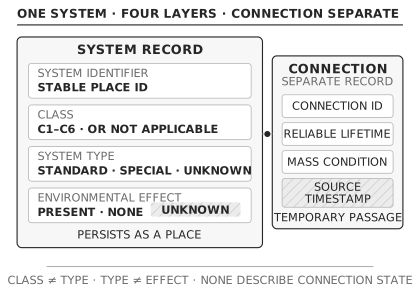
Anoikis becomes easier to reason about when its labels are kept in layers. A Pathfinder can then say what belongs to the system, what belongs to a special System Type, what belongs to an Effect and what belongs only to the temporary door used to arrive.
The purpose of classification is not to make every system predictable. It is to make different kinds of uncertainty visible.
Read the System
Chapter 3 read the Wormhole as a door. This chapter reads the place behind it. The two must remain separate.
The connection carries its own Type, Reliable Lifetime, maximum jumpable
mass and total mass condition. The destination carries a System Identifier,
a Class or special System Type and, in some systems, an Environmental Effect.
The connection may collapse while the destination remains. The destination
may be familiar while the new connection to it is not.
Begin with five questions:
- What is the System Identifier?
- Is the system one of the common Classes C1-C6?
- Does a special System Type apply?
- Is an Environmental Effect present?
- Which of these labels are Observed, Derived or merely Reported?
These questions do not all need an immediate answer before a scout can move. They prevent one answer from quietly standing in for the others. Knowing the Class does not verify the Effect. Recognising Thera does not evaluate the arrival Grid. Reading the destination does not update the condition of the Wormhole behind the ship.
The system is understood by accumulation. Each layer changes a different part of the decision.
The Six Classes
The common Wormhole Space systems are organised into six Classes, C1 through C6. Official guidance describes them as Classes of increasing difficulty. That progression gives a Pathfinder a broad order for the PvE environment and the demands that its content may place on a pilot or Fleet.
Broad is the important word.
A Class is not a complete encounter specification. The label does not identify the Site on the next Grid, provide a fitting, promise a reward or measure the pilots already present. C1 is not a synonym for safe, and C6 is not proof that every immediate action is fatal. The Class describes the system’s general content band. The present threat still has to be observed.
This distinction protects both new and experienced pilots. A new Pathfinder should not treat the lower end of the sequence as training space with no consequences. An experienced pilot should not allow a familiar Class to erase the differences between two systems, two routes or two moments in the same system.
Use C1-C6 to set the first scale of expectation:
- What level of preparation may the environment deserve?
- Does the intended operation belong in this general band?
- Which assumptions need verification before another ship follows?
The Class prepares the next question. Its answer still requires observation.
Class Is Context
Behind the short labels is a controlled data classification. In the current
Static Data Export, a wormholeClassID can be assigned to a Solar System, a
Constellation or a Region. When a system has no value of its own, the value can
be inherited from the larger structure that contains it.
For the pilot, the implementation detail carries a practical lesson: a Class label in a mapping tool is usually Derived information. It may be reliable and repeatable without being something the scout directly observed on the arrival Grid. Its Source is game data, a controlled reference or a tool built from either.
Derived does not mean weak. It means the reasoning remains visible.
The same data field also contains identifiers for kinds of space outside the common C1-C6 sequence, including Known Space categories and Pochven. Official developer guidance therefore warns that the field alone is not suitable for deciding whether a system is Wormhole Space. Context still matters, even in a classification built to provide context.
Most pilots never need to read the SDE. They do need to know what a map label can and cannot prove. A tool may identify the Class correctly while the map’s route, occupants and connection states remain old.
Beyond C1-C6
Not every important system in Anoikis fits inside the common six-Class sequence.
Current official data reserves distinct System Types for:
- Thera;
- special small-ship Shattered Wormhole Systems; and
- five kinds of Drifter Wormhole Systems.
These categories are not C7, C8 and C9. They do not continue the difficulty ladder. They distinguish places whose structure or access differs enough that forcing them into the ordinary sequence would hide the feature that matters.
This changes how a Pathfinder reads shorthand. Special does not necessarily mean more difficult, and a higher internal identifier does not mean a higher Class. A special System Type is a branch in the classification, not another rung above C6.
When a map gives one of these labels, read the label as a request for a different set of questions. What is special about the system? Which ordinary C-Class expectations no longer apply? Which facts must be checked from a current Source before the route is used?
Shattered Systems
Shattered is not one simple Class.
Standard Shattered Wormhole Systems were distributed across the existing C1-C6 Classes. Their planets are shattered, and they have no moons, but they still carry Class-appropriate Wormhole Space content. A system can therefore be both C2 and Shattered, or both C5 and Shattered. One label does not cancel the other.
This makes Shattered a useful test of layered reading:
- the C-Class describes the common content band;
- Shattered describes a different physical and operational System Type;
- an Environmental Effect, if present, remains another layer; and
- every current Wormhole connection keeps its own limits.
The special small-ship Shattered Systems are different again. Current official classification gives them a kind of their own rather than placing them in the ordinary C1-C6 sequence. Their access restrictions are the defining warning. A Pathfinder should verify the current Wormhole and intended hull instead of borrowing permission from a standard Shattered system.
The word Shattered therefore starts an inquiry. The inquiry remains open.
Thera Stands Apart
Thera is Shattered, but treating it as only another Shattered system would discard the part that makes it Thera.
Official data assigns Thera its own System Type. It is not classified as C3 or C4, even though its original design includes Wormhole content associated with those Classes. The distinction prevents content expectations from being mistaken for the identity of the system.
Thera was designed around NPC stations, exceptional scale and many Wormhole connections. That combination makes it behave less like an ordinary point in a C-Class Chain and more like a changing junction used by many unrelated travellers.
The operational consequence is not a list of special rules to memorise. It is a change of posture. A connection into Thera should raise questions about traffic, route age, station activity and the number of ways other pilots may arrive. The name identifies the place without making it controlled.
Thera demonstrates why System Type and Class cannot be treated as synonyms. A system can borrow content from a Class without belonging to that Class.
Drifter Categories
The official classification also separates five kinds of Drifter Wormhole Systems: Sentinel, Barbican, Vidette, Conflux and Redoubt.
These are System Type labels, not additional steps beyond C6. Their existence signals that ordinary C-Class expectations are incomplete. A Pathfinder who encounters one has entered specialised space and should resist filling the gaps with habits learned in a common C-Class system.
The distinction between Type and proper name matters here. The current SDE can give a Drifter system a present name that is not identical to the Type label used by the classification table. Record the current System Identifier and name separately from the category. If one changes, the other must not be silently rewritten to match it.
This volume does not turn Drifter Systems into a beginner route. It gives the reader enough structure to recognise that the common six-Class model has ended. Recognition is the safe first result.
Effects Stay Separate
An Environmental Effect is not a Class and not a System Type.
Official data currently distinguishes six Effect types: Magnetar, Black Hole, Red Giant, Pulsar, Wolf-Rayet and Cataclysmic Variable. The same
Effect type can occur across Wormhole Classes. Its presence adds another set
of consequences for the system; it does not replace the underlying Class.
A C-Class label therefore cannot answer the Effect question. Nor should an
Effect name be used as shorthand for the whole system. A Pulsar describes
the environmental modifier. The Effect name reports neither the Wormhole’s mass, the
Chain’s freshness or the pilots on the Directional Scanner.
Chapter 12 will examine what the Effects do. The Pathfinder’s task here is to keep the field open in the mental model:
Class known. System Type checked. Effect still Unknown.
That sentence is more useful than allowing the Class to imply an answer that was never observed or derived.
Not a Verdict
Classification reduces uncertainty by naming the kind of place. It cannot judge the present moment.
No Class or System Type reveals who is present, whether a Structure is active, whether the arrival Grid is watched, how old the Shared Map is, whether the return connection is healthy or what will follow the next command.
These current-state questions belong to Observation, Scanning, mapping discipline and the condition of each Wormhole. The Class may change the weight of evidence; it cannot supply evidence that was never gathered.
A lower Class cannot authorise carelessness, nor a special System Type panic. The label supplies context; the decision still needs a present picture.
Record the Layers
A Shared Map should make the layers easy to separate at a glance.
For each system, preserve:
- the System Identifier and current proper name, if one exists;
- the C-Class or special System Type;
- the Environmental Effect, or an honest Unknown;
- the Source and Timestamp of every changeable Observation; and
- each Wormhole connection as a separate object with its own state.
Stable classification data does not require the same Timestamp discipline as a Directional Scanner result, but it still needs a Source. A tool may update. A system name may change. A Report may use an old category. The record should reveal whether the label came from current data, a fresh Observation or another pilot’s map.
Do not compress the layers merely to make the map look clean. C4,
Shattered, an Effect and an ageing return connection are four different facts.
If they become one colour or one vague tag, the next pilot cannot tell which
part needs rechecking.
Good shorthand preserves distinctions. It makes the important sentence short without making it false.
Field Principle
A Class tells the Pathfinder what kind of environment may be ahead. A System Type tells which ordinary expectations may fail. An Environmental Effect adds another condition. None of them reports the pilots who are present or the health of the door behind the ship.
Name the system in layers. Decide from the whole picture.