The operation begins without drama.
A Pathfinder has a ship, a purpose and a connection into Anoikis. No threat report is active. An earlier check supports the route shown on the Shared Map. The available time appears generous.
This is where most operational discipline is won or lost.
Emergencies reveal habits created during quiet work. If the route was never given an owner, nobody knows whether its condition is current. If the stop condition was never discussed, time and profit slowly become reasons to continue. A complete-looking map may persuade the next pilot to stop testing it.
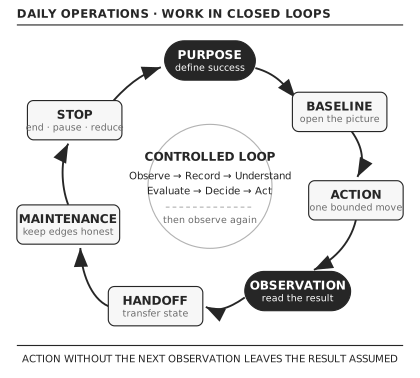
No single procedure defines a daily operation. Instead, daily work forms a controlled cycle that keeps purpose, exposure and return visible while the system changes.
Start With Purpose
Define what the operation is meant to produce.
Possible purposes include opening a route, checking existing connections, surveying a branch, supporting another activity or carrying a ship Home. Each asks for a different level of Scanning and a different stopping point.
Explore the Chain is too broad to control exposure.
Verify the current route from Home to Known Space, preserve both endpoints and report every unverified branch gives the operation an observable finish. It also says what does not need to be solved.
Purpose determines:
- how far the Chain must be extended;
- which edges need fresh condition;
- what ship capability must be preserved;
- which Unknowns can remain;
- what information must be handed off; and
- when the operation should stop.
The purpose may change after new evidence. Record that change. Otherwise, a small survey can become an open-ended commitment without anyone deliberately accepting the additional risk.
Know what success looks like before Anoikis offers something more interesting.
Define Exposure
Every task places something at risk: a ship, route, time window, cargo, group or the information another pilot depends upon.
State which exposure matters most.
A scouting hull may be replaceable while its return Bookmark is critical. A hauler may carry little personal risk but depend on a Chain whose mass state cannot tolerate unrecorded traffic. A fleet waiting at Home may turn one Pathfinder’s delay into many pilots’ lost time.
The exposure determines the evidence required.
A low-commitment branch check can proceed with Unknown activity beyond the next edge. Moving a valuable or slow ship may require a recently observed arrival Grid, current connection state and a scout holding the far side.
This is not a formula based on price. Replaceability, strategic importance and recovery all matter.
Before entry, complete one sentence:
This operation can tolerate [named uncertainty], but it stops if [named condition].
The blanks make uncertainty operational. They prevent every uncomfortable observation from becoming panic and every convenient observation from becoming permission.
Open the Picture
Begin with the current system rather than the remembered Chain.
Confirm the System Identifier, the available Wormholes, the Signatures and the Shared Map’s expected edges. Read the state of the connection that will carry the first commitment. Check whether Bookmarks are present, correctly shared and usable by the people who need them.
Then establish the immediate activity picture: Grid, Local disclosure, Directional Scanner and any reports from scouts beyond the first edge.
This opening does not need to resolve every Signature. It needs to expose where the old map and present system disagree.
Record:
- edges personally observed now;
- edges still supported only by reports;
- connections whose state has aged;
- new or missing Signatures;
- known activity and its Timestamp; and
- the first Unknown that could change the plan.
The operation starts from this baseline. Without it, later change has nothing reliable to differ from.
Do not spend the first minutes proving the map was right. Spend them finding where it may no longer be.
Assign Ownership
Information degrades when everyone assumes someone else is maintaining it.
For each critical function, establish an owner:
- who is extending the Chain;
- who is watching a key Wormhole Grid;
- who updates connection state;
- who maintains the Shared Map;
- who receives threat reports; and
- who decides that the operation stops.
In a small operation, one pilot can hold several roles. Naming them still matters. The same person then knows when workload exceeds attention.
Ownership is not exclusive authority over facts. Any pilot can report a change. It is responsibility for making sure the change reaches the common picture.
When ownership passes, use a handoff. Include the current system, route, critical Bookmarks and connection conditions. Add recent contacts, active timers and open Unknowns.
Map updated is not a handoff. It describes an interface action, not the state another pilot inherits.
Work in Loops
The field sequence becomes a loop during daily work:
Observe → Record → Understand → Evaluate → Decide → Act → Observe again.
The size of the loop should match the task.
For one Wormhole, it may begin with current Information, continue through a transit and end with an arrival-side Bookmark and new scan. For a branch survey, it may cover several systems before the Pathfinder pauses to reconcile the map.
Every loop needs a deliberate close.
Action without the second Observation leaves the result assumed. A transit without an arrival check does not confirm the mapped destination. Unverified Shared Locations do not confirm that the next pilot can use them. A threat response without a later baseline leaves the system permanently described by the alarm.
Closing the loop turns movement into knowledge. It also shows when the next loop should not begin.
Maintain the Chain
A Chain is useful only while its critical edges remain current enough for the traffic placed upon them.
Prioritise maintenance by consequence.
The only route Home, a connection carrying repeated fleet traffic and an edge near poor lifetime or mass condition need more attention than an unused branch. That attention can include a fresh Information reading, traffic records, a scout report or confirmation from both sides.
Retire collapsed edges promptly, but preserve enough history to explain why the route changed. A new Wormhole to a familiar system is a new connection with new endpoints and condition.
Do not make the map visually calm by hiding uncertainty. Use clear states such as Observed, Reported, Unverified and Expired. A provisional line can be used when the commitment tolerates it. A clean false line cannot be interpreted at all.
Maintenance is not finishing the Chain. It is keeping the important routes honest.
Manage Time
Several clocks move during an operation.
Wormholes age. Polarization histories expire and restart. Shared Locations may become usable after a delay. Reports grow stale. The pilot’s available session and attention also shorten.
These clocks should not be compressed into we still have time.
Name the time that matters:
- earliest connection concern;
- last direct observation of the return;
- recent transit times;
- deadline for the operation’s purpose;
- time needed to extract the slowest commitment; and
- reserve for a route that must be rebuilt.
The useful stopping point comes before the final minute. If every remaining minute is required for the intended route, the operation has no capacity for Anoikis to change.
Time reserve is not inactivity. The reserve keeps a changed edge from becoming an emergency by definition.
Communicate Changes
Routine reports should be shorter than the reasoning that produced them and more precise than a verdict.
Report changes that affect movement, exposure or shared understanding:
J123456, 15:10: new K162 resolved. Far side unentered. Home edge unchanged since 14:55. No ships or probes on latest broad scan from the inbound.
The report separates new fact, unverified space, aged state and bounded scan. That structure lets the next pilot decide which part matters.
Avoid flooding communications with every repeated negative scan. A baseline followed by meaningful changes preserves attention. When the operation requires continuous watch, agree how silence and regular status reports are interpreted.
If a report is uncertain, include the uncertainty. If a value came from another pilot, preserve that Source. When urgency prevents a complete report, send the immediate stop message first and add the evidence when position allows.
Communication should reduce the number of hidden assumptions carried by the group.
Stop Conditions
Quiet work needs an end that is not simply ship loss or exhausted time.
Possible stop conditions include:
- loss of a confirmed return route;
- connection state below the accepted commitment;
- activity the available support cannot evaluate;
- loss of probes, launcher or Bookmark access;
- Environmental Effect incompatible with the planned ship;
- workload beyond the pilot’s reliable attention; or
- completion of the defined purpose.
Completion belongs on the list. Continuing after success can expose the result without adding value.
A stop condition can lead to return, pause, handoff or a smaller objective. Other opportunities in the system need not be abandoned automatically.
When the threshold is reached, state it and act while options remain. Do not renegotiate the accepted risk only because the ship is already deep in the Chain.
Close Deliberately
An operation does not end when the Pathfinder docks or logs off.
Some edges still visible on the Shared Map may be used by another pilot. Temporary Bookmarks may need retirement. A connection state may need a final Timestamp. Threat reports may need to be closed or left active with clear ownership.
Close the information:
- mark which edges were last observed and when;
- retire connections confirmed collapsed;
- identify Bookmarks that remain operational;
- preserve unresolved Signatures and branches;
- record traffic that affects mass or Polarization;
- state where any pilot remains in the Chain; and
- hand off the next required check.
Do not erase the unfinished parts. They are the beginning of the next operation.
The best closing report tells another Pathfinder whether to trust, verify or retire each critical part. It leaves no silent obligation attached to a pilot who has already left.
Field Principle
Daily work keeps purpose, exposure, ownership, time and return visible while the Chain changes.
Open with a present baseline. Work in closed observation loops. Maintain critical edges by consequence, communicate meaningful change and stop while the result can still be brought Home.