The Directional Scanner shows no ship. Local has disclosed no speaker. The route Home is mapped, and the Pathfinder has already crossed its first two connections without incident.
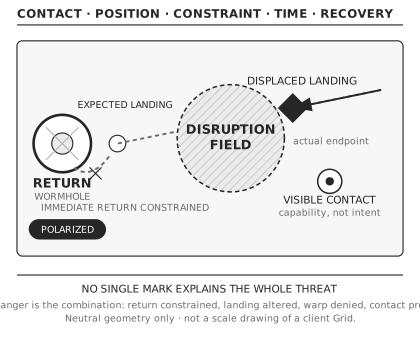
At the next Wormhole, the ship lands away from the expected point inside a Warp Disruption Field. A contact decloaks. The return direction is still Polarized.
No single instrument failed.
The threat existed in the relationship between an unseen pilot, a constrained landing, a recent transit and a route treated as immediate escape. Each part was survivable alone. Together, they removed the easy answer.
Common threats in Anoikis are rarely just a list of hostile objects. They are conditions that take away time, information or reversibility. The central task is recognising when those conditions begin to combine.
Threat Is Change
A ship type is not a threat by definition. A change that can interfere with the plan is operationally more useful to notice.
New probes appear. A connection changes mass state. A Wormhole activates on Grid. A known ship vanishes from the Directional Scanner. A route report ages past the commitment it was meant to support.
Each change creates a question before it creates a conclusion.
The Pathfinder should ask:
- What changed from the baseline?
- Which action could the change interfere with?
- How soon would that interference matter?
- What remains reversible now?
- Which observation could distinguish the plausible explanations?
This prevents the two familiar extremes. Dismissing every change allows pressure to build unnoticed. Treating every change as an attack spends attention and movement on stories the evidence never supported.
A threat picture is a set of capabilities and opportunities, not a claim about intention. It becomes urgent when capability, position and the Pathfinder’s exposure begin to align.
Silent Pilots
Chapter 9 established the limit: silent pilots cannot be counted through Local. Threat assessment adds a different question. What opportunity would an unseen pilot have against the present action?
Probes, Wormhole activation, unexplained ships, changed connection state or wrecks can narrow that question without identifying a hunter. None proves hostility. Together they may justify less exposure.
Do not defeat silence by inventing a location. Decide which actions remain reasonable if another pilot is watching. Sometimes movement preserves options; sometimes holding and refreshing the picture reveals less.
Wormhole Grids
A Wormhole Grid concentrates movement.
Pilots who want to observe or control traffic know that arriving ships must appear near the connection and that returning ships must come back to it. The Grid can therefore contain a scout, tackle, Warp Disruption Field or ships waiting beyond Directional Scanner range before being called in.
Post-jump protection gives the arriving Pathfinder time to observe. It does not make the Grid neutral. A ship command ends that protection, and the next action can reveal which route the pilot intends to take.
Before ending the pause, read more than visible hulls:
- the return Wormhole and its distance;
- deployed objects and disruption fields;
- nearby objects that could interfere with cloaking;
- the ship’s current Polarization and Session Change state;
- directions that remain available; and
- changes reported elsewhere in the Chain.
The first command should follow from this picture. Habitual movement gives an observer a predictable target.
A clear arrival Grid is encouraging but promises nothing about the far side of the next command.
Probes and Hunters
Scanner Probes reveal capability before they reveal purpose.
Chapter 10 separated Core and Combat Scanner Probe capability from identity and intent. Under threat, the sequence now matters most. Probes appearing after work begins, changing position or remaining near the relevant volume deserve more attention than one isolated return.
A ship appearing afterwards can increase concern without proving a common operator. Disappearing Probes may have moved, been recalled or left the next configured scan.
Report the time, volume and change from the baseline. Identity need not be known before avoidable exposure is reduced, but one Core Scanner Probe need not drive a sound position into panic.
Hunting is a process of reducing uncertainty. The Pathfinder survives by noticing when someone else may be reducing it too.
Warp Disruption
Warp Disruption Fields can prevent ships inside them from entering Warp and can alter the endpoint of a Warp towards a prepared field. They may be created by deployable structures or specialised ships.
The threat lies not only in the field, but also in the place where it causes the ship to stop.
A displaced landing can put the Pathfinder away from a Wormhole, beside objects that break a cloak or inside the reach of waiting tackle. A field on an otherwise familiar route can make an old Bookmark deliver the ship into a new situation.
Interdiction Nullifiers can protect eligible fitted ships from Warp Disrupt Probes and Mobile Warp Disruptors, but only under their current activation and fitting rules. Official guidance requires the module to be active before the Warp command. It also has a reactivation delay, and some fitted modules can prevent it from working.
Nullification is therefore capability, not immunity to every form of tackle. Read the module, the ship and the planned Warp before depending upon it.
The best time to notice a disruption risk is before the route has only one landing.
Site Defenders
Wormhole Space may contain hostile Sleepers. A Site category, resolved position or attractive container does not establish that the Grid is safe for the current ship.
Site danger varies with the Site, system and activity. Some locations contain NPC defenders. Others can introduce hazards or spawn responses after a trigger. A complete Site catalogue belongs in specialised references rather than a beginner’s memory.
The Pathfinder needs a firmer rule:
Do not enter an unfamiliar Site as though Scanning it also evaluated it.
Resolution provides location and identification, but cannot compare incoming damage, tackle, capacitor pressure or triggers with the fitted ship. Nor does it exclude another capsuleer already observing the Site.
Before entering, use a current Site reference and understand what causes the encounter to change. If that information is unavailable, record the Site and leave it uncommitted.
Curiosity is not the error. Turning an unknown encounter into an irreversible test is.
Changing Connections
The route itself can become the threat.
A Wormhole ages and carries traffic while the ship works. No hostile intent is required; dependence on a temporary door creates the exposure.
Watch the edges that carry the greatest consequence. The only return to a critical system deserves fresher condition than an optional branch, even when all known traffic is friendly.
When the state worsens, ask what follows the current ship, what lies beyond the edge and what recovery remains after collapse. A route can stay technically open while becoming operationally poor.
Effect Mismatch
Environmental Effects turn familiar performance into another source of risk.
A Black Hole can alter alignment assumptions, a Cataclysmic Variable local repair and a Wolf-Rayet shield resistance. The danger begins when a fit from another environment is trusted without revision.
Treat that mismatch like stale route information. Identify the function the operation depends upon and compare it with the current attributes. An earlier ship may have used a different defence, weapon size or support; a shared Effect still produces fit-specific consequences.
A threat does not have to be hidden. Sometimes it is displayed above the capacitor and ignored.
Bad Information
Errors in a Shared Map do not require deceit.
An edge may have collapsed. A Bookmark may refer to the wrong endpoint. A report may omit its filter. An automated mapping event may have inferred the wrong connection. A correct observation may simply be too old.
Bad information becomes dangerous when it looks complete enough to stop verification.
Preserve Source, Timestamp and disagreement. Mark an edge Unverified instead of forcing two Reports into one clean answer. I think this is the inbound is not a route state; confirm the object and relationship or leave them Unknown.
Shared trust grows when every pilot can see which parts have been checked and which next edge still needs testing.
Human Overload
The pilot is part of the threat picture.
Ship control competes for attention with the Directional Scanner, Probe Scanner, Local and Overview. The map, communications and Wormhole state demand attention too. Under pressure, the mind tends to narrow around the most vivid signal and drop quiet dependencies.
A visible hostile ship can make the Pathfinder forget Polarization. A collapsing route can pull attention away from a new Grid contact. Repeated Scanning can continue while the filter is wrong.
Reduce this load before it peaks.
Use stable labels. Keep important windows readable. Decide stop conditions in advance. Report changes in a consistent form. Let another pilot own part of the observation when the group is available.
Perfect awareness is not the goal. Preserve the route, ship state and next reversible action so that one surprise cannot erase all three at once.
When the picture becomes too crowded to interpret, reducing commitment is a valid decision.
Threats Combine
Threats gain force by removing different options together.
Polarization removes one immediate direction. A Warp Disruption Field removes Warp. A cloaked pilot removes warning. A weakened Wormhole removes confidence in the route. The local Effect changes the performance used to escape.
No checklist can predict every combination. A common framework can still expose them:
- Contact: What can act against the ship?
- Position: Where can that capability reach?
- Constraint: Which movement or system is already limited?
- Time: Which condition changes next?
- Recovery: What remains if the intended action fails?
The strongest warning is often not a dangerous object, but the discovery that two independent escape assumptions depend on the same fragile edge.
Before increasing exposure, find the single failure that would make several other problems irreversible. That is where another observation or different plan has the greatest value.
Decide Early
A stop condition made before contact is easier to use during contact.
Pre-set stop conditions might include unexpected Combat Scanner Probes, an unverified return edge, a particular Wormhole state or loss of Scanning capability. The threshold should match the ship, purpose and support.
This is not cowardice encoded as procedure. It prevents sunk time from silently changing the accepted risk.
When the condition occurs, observe and report it. If the picture differs from the condition anticipated, a new decision may still be reasonable. What should not happen is continuing by default because the ship has not yet been attacked.
Leaving early can preserve route knowledge and expose the threat to the next operation. Remaining can be correct when the ship retains control and the new information supports it.
Certainty is not required before action. The reason for acting must survive the surprise.
Report the Threat
Hostile in system may be urgent, but it is often incomplete.
A useful report separates the observation from the assessment:
14:42, return Wormhole Grid: Sabre visible, Warp Disruption Field active, two additional ships on broad scan. A-to-B Polarization remains for approximately one minute. Assessing Grid as hostile; do not jump.
The visible ship and field are Observed. The additional contacts belong to a bounded scan. The timing comes from the pilot’s history. Hostile is the operational assessment that follows.
If identity or intention remains Unknown, say so. When the connection state has not been rechecked, the threat report must not imply that the route is healthy.
Good reporting gives the group options. It can stop traffic, redirect a scout, protect an alternative route or reveal that another pilot has better information.
The report should make the next decision faster without pretending to remove its Unknowns.
Field Principle
A threat is any condition that can remove information, time or reversibility from the operation. Ships, probes and Sleepers can all contribute. Disruption fields, Effects, changing connections and human attention can do the same.
Build the picture from capability, position, constraint, time and recovery. Act before several small uncertainties become one irreversible event.