Three systems from Home, the Pathfinder finds the expected Wormhole missing.
The Bookmark is still present. The old edge remains drawn on the Shared Map. The previous report was correct when it was made.
Warping to the position proves only that the old door is gone.
Home has not disappeared. The route that represented it has changed. Recovery uses the same skills as entry: observe the current system, preserve what remains, scan what is hidden and refuse to make one failed edge mean there is no way back.
Returning Home is not reversing a recorded list of jumps. The return is a new operation whose purpose is to deliver the ship, pilot and useful knowledge to the intended destination.
Define Home
Home is a destination, not a direction on the map.
For one pilot, it may be a particular Known Space station. For another, it may
be a Wormhole Structure or the starting system of the expedition. A Chain
alias such as Home can represent that destination, but it should not replace
the identity another pilot needs to verify.
State the return objective precisely:
Reach the original departure system with this ship and preserve any changed route discovered on the way.
This definition distinguishes success from partial progress. Reaching Known Space through an unexpected exit may solve the Anoikis route while leaving a long or dangerous journey to the actual destination. Reaching a familiar Wormhole system may still leave the final connection unverified.
The word home carries comfort. The route deserves the same evidence as any other destination.
Begin Outbound
The return begins during departure.
Each arrival-side Bookmark preserves a possible next step back. Each mapped edge records the relationship the ship may later depend upon. Its Timestamp shows how old that support will be when the pilot turns around.
That discipline cannot promise a return from every outward transit; Wormholes remain temporary. Instead, the Pathfinder leaves enough structure for change to be recognised.
Before going deeper, ask:
- Is the current return endpoint preserved?
- Does the Shared Map identify both systems and this connection?
- What is the latest lifetime and mass Observation?
- Which other pilot or tool holds useful route information?
- What capability remains if this edge is gone later?
The answers set the cost of the next step.
Without a describable route back before departure from the present system, extending the Chain becomes the replacement of navigation with hope.
Read the Route
Before moving Home, read the entire expected route as a set of claims.
For every edge, identify:
- the two systems it is believed to connect;
- the usable Bookmark on the near side;
- the Source and age of its latest confirmation;
- current lifetime and mass condition, when relevant;
- known traffic since that observation;
- ship-size compatibility; and
- an alternative if the edge fails.
The route may contain different confidence levels. The next edge may be Observed. A middle edge may be Reported by a fleet member. The final edge may be old but still plausible.
Do not call all three mapped and treat them equally.
Prioritise verification where failure has the greatest consequence. Where the ship can still return to a safe working position, test the uncertain edge before moving every following commitment towards it.
A route is ready when its uncertainty fits the ship and recovery, not when every line shares the same colour.
Test Each Edge
Traverse Home one connection at a time.
Before Warp, confirm the current system and intended Bookmark. On the Wormhole Grid, confirm the object, read its present condition and compare visible details with the route record. Refresh the activity picture appropriate to the commitment.
After transit, confirm the destination. Preserve or verify the far endpoint. Update transit time, mass relevance and the state inherited by the next edge.
This rhythm catches errors close to their cause.
The wrong Bookmark can be stopped before Warp. A deteriorated Wormhole can be reassessed before transit. An unexpected destination can be contained before the Shared Map is updated as though the planned route succeeded.
Do not let the familiarity of returning remove the arrival check. The far Grid can contain new contacts, a disruption field or a route change that was not present outbound.
Every successful edge earns the right to evaluate the next without guaranteeing it.
Refresh Activity
The outbound activity picture is history by the time the ship returns.
The limits established in Chapters 9 and 10 have not changed. Silent Local does not supply a roster, and an earlier Directional Scan belongs to another position and time. New connections may have carried ships into the system since both were observed.
A return Wormhole can be attractive to an observer because traffic is expected to use it. Probes seen earlier may have resolved the same connection. A route shared with others can have generated additional mass and attention.
Refresh the evidence before exposing the ship to that predictable route. Report meaningful changes without linking them beyond the evidence. A ship near the return direction may be relevant; it is not automatically the pilot who launched earlier Probes.
Refreshing cannot prove the route safe. It prevents an old quiet system from authorising a new transit.
Carry the Clocks
Return movement creates Polarization as it proceeds.
Recent edge use may have come from checking it, retreating from a threat or following another ship through. Each pilot can therefore approach the same Home route with different directional histories.
Before depending upon a quick reversal, record the last transit on this connection in the intended direction. Keep the ten-second Session Change, five-minute directional history and Wormhole condition separate.
The route can be open while one pilot is blocked. A second may be clear while the Wormhole can no longer carry the ship.
If waiting is required, update the rest of the picture during the interval. Do not watch one clock while the Grid, connection and following route age unseen.
Time belongs to navigation when the door remembers how the pilot used it.
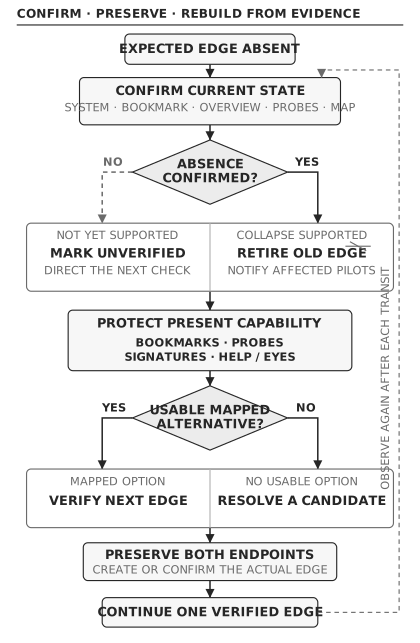
Missing Edge
When an expected Wormhole is absent, stop treating the old edge as current.
Confirm the system and Bookmark. Check whether the object is truly gone rather than hidden by Overview settings or a mistaken position. Reconcile the Probe Scanner and Shared Map.
Once collapse is confirmed:
- retire the connection as collapsed;
- preserve the systems and other edges;
- note the time and Source of the failure;
- tell pilots who might travel towards it; and
- identify which part of the return is now unverified.
Do not attach a replacement Wormhole to the old edge because it appears in a similar area or leads to the same kind of space. Resolve it, enter it when appropriate and create a new relationship.
The old route has ended. The return problem has changed from following to finding.
Protect the Present
Before searching for a replacement, secure the information and capability that remain.
Confirm the current System Identifier. Preserve usable Bookmarks. Keep probes available and the launcher functional. Record every unresolved Signature. Identify other mapped branches and pilots who may hold far-side positions.
Then report the situation precisely:
J123456, 16:05: expected Home edge confirmed collapsed. Current system, probes and two other mapped connections available. New Signatures ABC-123 and DEF-456 unresolved. Beginning replacement search.
This turns lost into a bounded problem.
Panic tends to spend the remaining assets. Probes are left behind. An unidentified Wormhole is crossed without preserving its endpoint, or an old map line is followed because it points in the desired direction.
Treat the present system as the new starting point, not as failure.
Find Replacement
A replacement route is discovered through the same disciplined sequence as the original.
Resolve Signatures. Preserve candidate Wormholes. Read destination clues and condition. Enter only when the ship and recovery can tolerate the Unknown. Bookmark the far endpoint and build a new edge from the actual destination.
The new route may reach Home directly, reach Known Space or connect with another recognised part of the Chain. It may also lead away from the intended destination.
Progress should be measured by verified options, not by the emotional sense of moving closer.
A deeper Chain can still improve the return if it adds usable connections and maintains recovery. A Wormhole that feels promising but cannot support the ship or lacks sufficient lifetime may not.
Share the new route with Source and Timestamp. Help becomes possible only when the replacement is more than a private trail of Bookmarks.
Use Other Eyes
A second pilot can observe a side the Pathfinder cannot.
A fleet member at Home may still hold the far endpoint of a connection. A scout can test an uncertain middle edge before the main ship arrives. A pilot in Known Space can evaluate the ordinary route from a new exit to the final destination.
Ask for bounded information:
Can you confirm the J123456 side of connection X still exists and report its current condition?
This is more useful than Is the route open? The answer carries position, object and required observation.
Preserve the difference between direct Observation and another pilot’s Report. Shared work increases coverage; it does not merge viewpoints into one omniscient map.
When help is unavailable, reduce the commitment to what the solo Pathfinder can verify. Waiting, holding a safe position or searching a smaller branch can be better than moving a ship into an unsupported route.
Independence includes knowing when another set of eyes would materially change the decision.
Known Space
Reaching Known Space changes the navigation model but may not complete the return.
Local, Stargates, Security Status and route planning become relevant under their ordinary Known Space rules. The Wormhole endpoint behind the ship still deserves a Bookmark if the route may be needed again.
Relief must not erase the last Wormhole observations.
Record the Known Space system, connection condition and time. Tell the group whether the exit is High, Low or Null Security space and whether the onward journey has been evaluated. A route to Known Space is not automatically a safe route to the final destination.
Detailed Known Space travel lies outside this book’s scope. The transfer of responsibility does not. The important boundary is knowing when the Anoikis route has ended and which different risks now govern movement.
Home is reached when the defined destination is reached, not when the stars become familiar.
Close the Route
Arrival creates one final obligation: leave the route honest.
Update the Shared Map with the edges actually used. Mark failed and collapsed connections. Timestamp the last condition of any exit another pilot may use. Retire temporary Bookmarks that have lost their object, while preserving records still needed for review.
Report:
- the destination reached;
- the route used;
- which edges were directly confirmed;
- any new replacement connections;
- traffic and timer information still relevant;
- pilots or assets remaining beyond the route; and
- the next required verification.
Then separate the completed return from the continuing Chain. The fact that one ship arrived does not promise the same route to a later ship.
A good return leaves two results: the Pathfinder is Home, and the map tells the truth about how that happened.
Field Principle
Home is a destination reached through present connections, not a command that replays the outbound path.
Read the expected route as a set of claims. Confirm each edge before depending upon it. When an edge fails, protect the current system and rebuild from evidence. Complete the return by closing the route record behind the ship.