The Local window is open. No other name appears.
On the Wormhole Grid, a set of Core Scanner Probes vanishes before the Pathfinder can narrow the Directional Scanner. A moment later, a wreck appears on a different scan. Nothing has spoken. Nothing in Local explains either change.
The title of this chapter is deliberately severe. Local exists as a chat channel in Wormhole Space. What does not exist is the automatic population roster pilots learn to expect elsewhere.
That missing roster changes more than one window. It removes the easiest shortcut between I see no name and no one is here. Survival begins when the Pathfinder stops asking Local to count the system and starts building presence from evidence with known limits.
A Missing Roster
Local in Wormhole Space uses delayed mode. A pilot does not automatically appear in its population listing merely by entering the system. The pilot becomes visible there by speaking.
This means the window answers a narrow question:
Who has revealed themselves through Local?
The broader question remains unanswered:
Who is present?
The difference is fundamental. A silent scout, a cloaked observer, a hunter crossing the system and a resident waiting near a connection can all remain outside the list. An empty list may exist beside an active operation.
Elsewhere, pilots can use Local as an early change detector. A new name appears, and attention turns towards the possible arrival. In Anoikis, the arrival can happen without that signal. The first warning may instead be a ship on Grid, probes in space, a new Signature or an old route changing under traffic.
Local has not become broken. It is operating under a different information model. The error comes from carrying an old interpretation into that model.
Silence Has Limits
Silence is an Observation, but only when its boundary remains attached.
At 14:10, the Pathfinder can observe that Local shows no other speaker. That statement is precise. It records what the client displayed, where and when. It may support a decision when combined with other evidence.
The statement the system is empty goes further. It converts one silent channel into a census. The interface did not supply that conclusion.
This distinction prevents two opposite mistakes. The first is comfort: nobody is listed, so the ship acts as though nobody can interfere. The second is panic: because Local cannot prove absence, every system is treated as though an attack is already under way.
Neither response reads the evidence.
A silent Local removes one possible disclosure. It neither adds nor removes a threat. The decision must come from the remaining observations, the value at risk and the cost of another check.
Uncertainty is not a hidden enemy. It marks the limit of the available claim.
Speech Reveals
Speaking in Local changes the information available to everyone receiving the channel. The message carries content, but the act also reveals the character to the population listing.
That disclosure deserves intent.
A greeting may invite contact. A warning may prevent a misunderstanding. A public message may be part of an operation. None is automatically wrong. The mistake is treating speech as though it were private conversation that leaves the surrounding picture unchanged.
A name in Local also proves only that the pilot revealed themselves through communication. The list does not identify the pilot’s current Grid, ship, purpose or relationship to anything detected elsewhere. A speaker may be harmless, hostile, departing or deliberately distracting.
Do not join a visible name to a Directional Scanner contact merely because both are available at the same time. That relationship is Derived and needs support.
Local is therefore useful evidence when it changes. It can establish that a character chose to speak. It cannot turn that character into the explanation for every unexplained object in the system.
Presence Leaves Traces
Pilots who remain silent can still alter the environment.
A ship may enter a Directional Scanner volume. Core or Combat Scanner Probes may appear. Drones, wrecks or deployed objects may suggest current or earlier activity. A connection can change mass state. A new K162 can become visible among the system’s Signatures. Movement reported by another pilot may enter the Shared Map.
Each trace answers a different question.
A wreck establishes that destruction occurred, not who caused it or whether the cause remains nearby. Probes establish that probes were within the scan volume when measured, not which pilot launched them or which result they are pursuing. A new connection establishes a route that was not in the earlier picture, not that a hostile fleet is already using it.
These traces become useful when they are allowed to remain partial. Together, they can raise or lower confidence in a quiet system. Separately, none should be forced into a complete story.
The Pathfinder is not trying to reveal every hidden pilot. The task is to notice whether the present evidence still supports the next commitment.
Evidence Has Reach
Every observation covers a volume, a moment or a configured view.
The Overview describes the current Grid through its active settings. The Directional Scanner reaches beyond the Grid, but only through its selected range, angle and filter. The Probe Scanner exposes Signatures and Anomalies, not a live list of ships. Reports from other positions and times live on the Shared Map.
Their limits do not make them weak. Their limits make them interpretable.
Suppose Local is silent, the current Grid is clear and a broad Directional Scan returns no ship. The Pathfinder has assembled more evidence than Local alone could provide. Yet the result still excludes pilots beyond the scan range, outside the eligible object types or hidden by mechanics the scanner cannot overcome.
The correct conclusion may be:
No visible ship was returned from this position by this scan; Local has disclosed no speaker.
That is not timid wording. It gives another pilot the exact support for the present assessment and reveals what another position or later scan might add.
Confidence grows by joining bounded observations, not by removing their boundaries.
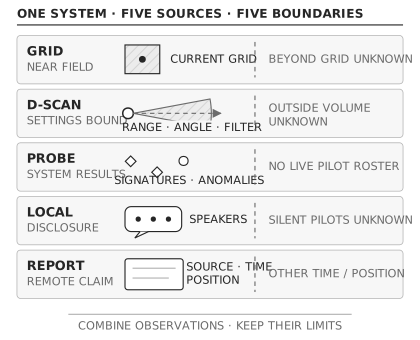
Build a Watch
Awareness in Anoikis is a repeated comparison, not a single clearing action.
The Pathfinder first establishes a baseline: the current Grid, Local, a broad Directional Scan, the known Signatures and the relevant edges on the Shared Map. The baseline need not prove safety. It describes the system closely enough that later change can be recognised.
The next observation is valuable because it can differ.
A ship appears where none was returned before. Probes disappear. A connection changes condition. A reported pilot fails to arrive. The difference may carry more meaning than either snapshot alone.
The rhythm should follow exposure. A ship lingering uncloaked at a valuable site needs a shorter interval between checks than a cloaked scout holding away from traffic. A fleet waiting to cross may need reports tied to the connection rather than general statements about the system.
Habit helps only while it serves the question. Repeating a scan without noticing its filter or allowing Local to occupy attention can create activity without awareness.
A good watch knows what could change the decision and checks for that change before the decision becomes difficult to reverse.
Count No One
Without a roster, population estimates become tempting.
One Structure, two scanner probes and a wreck can become three residents in the mind. A single ship type can become one pilot. Several ships can become a fleet. The system begins to feel counted even though the observations never supported a number.
Avoid that false precision.
Structures can outlast their users. Objects can be abandoned. One pilot can control different ships over time, while several pilots can produce similar traces. Directional Scanner results can overlap activity from different locations and moments.
Operational language should describe contacts and evidence:
- one visible ship on the current Grid;
- two ship returns on the latest broad scan;
- Core Scanner Probes newly observed;
- no speaker disclosed in Local; and
- population Unknown.
This report is longer than two in system, but it is much harder to misuse. It also allows the next observer to recognise which part changed.
The Pathfinder rarely needs a perfect census. The immediate need is to know whether present contact, possible contact or unexplained change alters the planned action.
Report the Silence
Reports about a quiet system often lose their boundaries in transmission.
Clear can mean the Grid was empty, no ship appeared on a broad Directional Scan, no combat contact was found, or simply that the speaker saw nothing unusual. Its recipient must guess which meaning was intended.
Replace the verdict with the observation that supports it.
A useful report can contain:
- the system and observing position;
- the time of the latest check;
- what Local disclosed;
- the Directional Scanner range, angle and relevant filter;
- ships, probes or activity traces returned; and
- what remains outside the observation.
The report does not need every unchanged object. It needs the settings and facts that another decision depends upon.
J123456, 14:10: no Local speakers; broad ship-and-probe scan from the inbound Wormhole returned no contacts. Far system not yet checked.
That sentence preserves silence without turning it into safety. It also directs the next useful observation.
Speak Deliberately
Local can still serve human purposes in Wormhole Space.
Pilots may communicate after an accidental encounter, answer a rescue effort or identify themselves when an operation requires it. The delayed roster does not make every message a mistake.
It makes every message a disclosure.
Before speaking, the Pathfinder should understand what the message is meant to achieve and what information the act gives away. Silence may preserve ambiguity. Speech may reduce it for both sides. The better choice depends on the people involved and the consequence of being identified.
The same discipline applies when someone else speaks. Do not answer automatically. Observe the message, record the character if relevant, compare the timing with other changes and decide whether a response improves the situation.
Communication is an action within the field, not a window outside it. It can change behaviour, reveal attention and invite further contact.
Use it for a reason.
Recheck the System
The most dangerous quiet is the quiet remembered after the observation has expired.
A Pathfinder enters, scans once and finds no contact. Ten minutes later, the same system is described as empty because nothing dramatic interrupted the work. In that interval, Wormholes may have carried traffic, probes may have crossed a volume between scans and a cloaked observer may have remained undetectable throughout.
The original scan can remain true. Its authority has changed.
Rechecking does not mean repeating every instrument at a fixed rate. It means matching freshness to consequence. Before leaving a defensible position, crossing an ageing connection, exposing a valuable ship or committing a group, refresh the evidence that action depends upon.
When new evidence disagrees with the baseline, pause the story. A newly visible ship is not automatically the owner of the earlier probes. A missing wreck did not erase the fight. Record the change first; derive the explanation second.
Survival does not come from making uncertainty disappear. It comes from noticing when an old answer is being asked a new question.
Field Principle
Local in Wormhole Space is a channel of voluntary disclosure, not an automatic population roster.
Treat silence as a bounded Observation. Build presence from Grid, scans, Signatures, connection state and shared reports. State what those Sources showed, when they showed it and what remained beyond their reach.