The Wormhole falls behind as the ship warps. A planet replaces it on the screen, then a moon, a Structure or the empty distance between Celestials. The system begins to look less like an arrival and more like a place.
That impression is correct. The ship has not entered a temporary room created for one visitor, nor is it travelling inside the Wormhole itself. It has arrived in another solar system: a shared location that can be crossed, occupied, remembered and revisited. Other pilots may already know it well.
What changes is not the reality of the place. What changes is the way the place can be reached.
Known Space builds the route into the landscape. Stargates remain at their posts, system follows system and the Autopilot can calculate a path through the network. In Wormhole Space, the systems remain while the doors between them move. A connection that defines the present route may be gone before the next operation. Another may open the same system toward a part of New Eden that was nowhere near yesterday’s Chain.
This is the nature of Wormhole Space: stable places behind unstable access. Understanding that contrast turns an apparently empty collection of systems into an environment that can be read.
Space, Not Passage
The words Wormhole and Wormhole Space are easy to let blur together. In the field they describe different things.
A Wormhole is a connection. It relates two locations for as long as that connection remains available. It can be approached, observed, crossed and recorded. Its condition matters because every plan using it depends on that particular door.
Wormhole Space is the collection of solar systems reached through such doors. The transit does not suspend the ship between two ends of a tunnel. It finishes in a system with its own star, planets, moons, Sites, Signatures and history. The Wormhole used to enter is one object within that system, not the system itself.
The distinction becomes clearest when a connection disappears. The system on the far side is not destroyed. Its Celestials do not vanish with the route, and pilots already there do not cease to occupy the same shared space. Only that way of reaching them has ended.
This separates two questions that are often treated as one:
- What is true of this system?
- What is true of my present connection to it?
A Structure may remain where it was while access to the system changes completely. A Site may still exist after the route by which it was discovered has collapsed. A pilot may know the system and still have no current route to it. Confusing place with passage makes old knowledge look more useful than it is.
Persistent, Not Fixed
Wormhole Space is persistent. It is not fixed.
Persistence means the destination is part of the shared universe. A pilot who returns to the same System Identifier has returned to the same solar system, not to a fresh copy made for a new visit. Celestials retain their relationship to that place. Player activity can leave infrastructure, wrecks, records and expectations behind. Familiarity can make a system feel like home.
Fixed would mean that access to it can be taken for granted. That is the part Anoikis refuses.
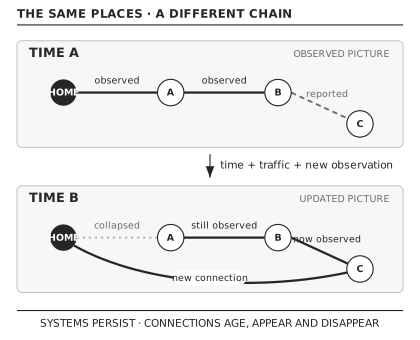
The route visible on a Shared Map is a temporary arrangement of persistent places. Its lines show which doors were available when the Chain was observed. They do not turn those doors into permanent roads. If one line disappears, the systems at either end continue, but the operation must live with a different shape.
Residents and travellers can therefore see the same system differently. A resident may know the Celestials, common warp paths and Structures from long experience. A traveller may know only the Entry and the next Signature. The resident has deeper knowledge of the place. Neither pilot receives a permanent claim on the route.
Familiarity therefore runs on two clocks. Knowledge of the system may remain useful for a long time. Knowledge of the current access may decay in hours or minutes. A good record makes clear which clock it is carrying.
No Gate Network
There are no Stargates forming a permanent network between ordinary Wormhole Space systems. The absence matters most when the pilot asks the interface for a route.
Setting a destination in Known Space lets the Autopilot work over an established network. The route may be long or dangerous, but the system can name the planned sequence of gates. A pilot can share a destination and expect another client to calculate from the same network.
Anoikis provides no equivalent route Home. The System Identifier is an address, not a set of directions. The Autopilot cannot reconstruct the connections the scout crossed, cannot know which scanned Signature became which Bookmark and cannot preserve the meaning of a Shared Map.
The missing network shifts responsibility from infrastructure to observation. If nobody records the Entry, the client will not rebuild the path out of kindness. If a connection is misidentified, the error becomes part of every route that relies on it. If the Chain changes, the old route does not become a slightly inaccurate road. It becomes a record of doors that may no longer exist.
This does not make navigation arbitrary. It makes navigation local. Each line must be discovered from one system, connected to observations on the other side and kept only as confidently as its evidence allows.
Uncharted, Not Empty
Wormhole Space is often called uncharted. A first arrival can make that word look like untouched.
That conclusion does not follow.
Uncharted describes the absence of a permanent public route network. It says nothing about who has crossed the system, who may be living there or what has been built beyond the current Grid. A Structure on the Overview is an obvious correction to the fantasy of an untouched frontier. So are wrecks, Scanner Probes and practiced responses from pilots who know the Grid better than the visitor does.
Even a system with no visible player infrastructure is not a blank stage. Wormhole Space can contain Sites occupied by Sleepers. Signatures and Anomalies give the system its own opportunities and threats. Their presence does not identify the other pilots nearby, and their absence from one display does not prove that the place has no history.
The useful reading is narrower:
- Uncharted: no permanent gate route describes how to reach this system now.
- Empty: no one is present or using it.
The first may be a sound description of Wormhole Space. The second is a claim that requires evidence the arriving pilot rarely possesses.
This distinction changes behaviour without requiring fear. A Pathfinder does not need to imagine an ambush behind every moon. The pilot needs only to stop treating a missing chart as proof that nobody else has drawn one.
The Living Chain
As soon as two connections are recorded, a Chain begins to appear. The term is simple, but the object it describes is more than a list of systems.
A Chain is the present shape of access known to a pilot or group. It may branch into several Wormhole Space systems, return toward Known Space in more than one place or end at Signatures that have not yet been resolved. Each line rests on an observed transit or another record. Each open end is work not yet done.
The Chain is alive because its meaning changes while it is being used. A connection ages. Traffic passes through it. Another scout adds a branch. A Reported line is checked and becomes supported by a fresh Observation. A door disappears, leaving the systems on the map but removing the route between them.
To a Pathfinder, that movement creates three versions of the same Chain:
- the Chain that exists in space;
- the Chain the group has observed; and
- the Chain the Shared Map currently represents.
Those versions are never guaranteed to match perfectly. Space may have changed since the last scan. A pilot may have crossed a connection without reporting it. The map may preserve a branch that has already died. Good mapping narrows the distance between the three; it cannot abolish time.
This is also why a Chain has no natural centre. The system called Home may be
the centre of an operation, but the connections do not share that preference.
From another pilot’s Entry, the same map has a different beginning. From a new
Known Space exit, a remote branch can suddenly become the shortest way out.
The map is therefore best read as a set of current dependencies. To reach the third system, the plan depends on the first two connections. To return from it, the plan depends on those doors remaining usable or on the ability to find a different route. The shape matters because every additional line can create an option, a burden or both.
Near and Far
Distance in Anoikis is not measured only in jumps.
A system one connection from Home may be operationally far away if that connection is old, poorly recorded or already under pressure. A system several connections deep may feel closer when every Entry is current, the route has been checked and alternatives are visible. The number of jumps is real. It is simply not the whole cost of return.
Known Space can also become unexpectedly near. A short Chain may open between regions that the Stargate network places far apart. For as long as the route survives, geography has folded. When it closes, the old distance returns.
For a Pathfinder, distance therefore carries another question. Ask not only, How many connections away? Ask also:
- How many of those connections have been observed recently?
- How many have no recorded alternative?
- How much of the route depends on someone else’s Report?
- What must remain usable for the next action to be reversed?
These questions do not create a number for the map. They reveal the weight hidden inside a short route.
Home Is Conditional
In a Stargate network, Home is primarily a destination. In Anoikis, Home is also a condition.
The familiar system may persist, but reaching it still depends on temporary doors. On the map, a pilot can appear close to Home and be operationally separated from it. Losing one connection can turn a routine return into fresh exploration without moving the destination.
That is why another exit is not the same as the route Home. An exit to Known Space may save the ship while leaving it many Stargate jumps from the intended destination. A new path through Wormhole Space may rejoin the original Chain, but until it is observed, it is a possibility rather than a plan.
Treating Home as conditional changes the purpose of every record. A Bookmark does not merely save a location. Likewise, displaying progress is not all a Shared Map does. A Timestamp does not merely satisfy procedure. Together they preserve the conditions under which the group believes return is still possible.
The condition can fail. When it does, the right response begins with the same discipline as the first arrival: preserve what is known, identify what changed and work outward from the routes that still exist. Panic imagines the whole of Anoikis closing at once. Observation asks which door was actually lost.
Field Principle
Wormhole Space is stable enough to inhabit and unstable enough that every route remains work.
The systems persist. The connections do not promise to. Uncharted does not mean empty, close does not always mean reachable and a familiar Home still depends on temporary doors.