The Probe Scanner is already open. One result is complete. Several others are little more than identifiers and coloured indications. In the Solar System map, the probes form a pattern around a point that may or may not be the point the Pathfinder needs.
The window appears to offer a list of places. At first, it does not.
It offers a mixture of located sites, unresolved signals, probe positions, filters and the record of the latest measurement. Some entries can be used at once. Others are evidence that something can be found without yet providing a place to which the ship can warp.
That distinction is the foundation of Scanning. The Pathfinder is not asking the client to name everything hidden in the system. The Pathfinder is using a measurement to reduce an area of uncertainty until a useful location remains.
The mechanics reward precise manipulation. The habit behind them is more important: never ask a scan result to be more complete than the pass that produced it.
A Different Picture
Scanning changes the Pathfinder’s relationship with the system. The Overview and the Grid begin with what the ship can presently display around itself. The Probe Scanner begins with possibilities distributed across the wider Solar System.
The Sensor Overlay can offer an overview of exploration sites and a general direction. The second window adds a working surface on which probes and results can be examined. Neither window turns every indication into a resolved destination merely by displaying it.
This matters because visual presence is persuasive. A marker on a map feels more like a place than a sentence saying something may be there. Yet the marker may still represent an area, an estimate or a result that is not warpable.
Read the interface as a statement of resolution. It shows what kind of answer the client can support at this stage of the search.
A completed result answers where can I act? An unresolved result answers a different question: where should the next measurement be concentrated?
Confusing those questions makes the scan feel unreliable. Separating them reveals that the result is doing exactly what it should: changing shape as the available evidence improves.
Two Result Types
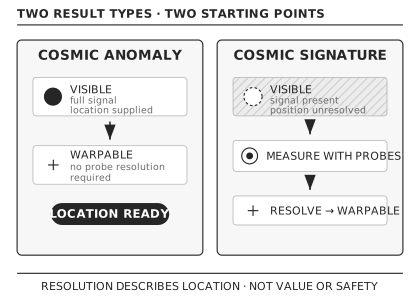
Its result list presents two kinds of exploration result that must not be treated as interchangeable:
- Cosmic Anomalies are already located. They do not require probes and can be selected as warp destinations without probe assistance.
- Cosmic Signatures indicate hidden sites. They require Core Scanner Probes to locate before the ship can warp to them.
A Cosmic Anomaly therefore begins as an available destination. Its appearance at full signal strength does not mean the site is safe, empty or worth running. It means the location problem has already been solved by the client.
A Cosmic Signature begins with a different promise. Something is present to be resolved, but the first indication does not yet supply a destination. The Pathfinder must build that location through probe measurements.
The difference is about access to a position, not the value of the site. A warpable Anomaly may be irrelevant to the operation. An unresolved Signature may be the next Wormhole in the Chain. Resolution and importance are separate judgements.
The result list becomes easier to read when each entry is given the right question. For an Anomaly: Do I have a reason to use this known location? For a Signature: Do I have a reason to spend attention resolving it?
Visible, Not Located
A visible Signature is not a contradiction. Visibility tells the Pathfinder that the scanning system has exposed a signal. Location asks whether the client has narrowed that signal to a usable point.
Between those states lies the work of Scanning. Early results carry less positional certainty. Later results can identify more about the Signature and place it more precisely. Only the resolved result supports a direct warp.
Signal progress is therefore not a probability that the site exists. The Signature already supplies the reason to search. Progress describes how well the present measurement has resolved it.
Nor is signal progress a measure of distance from the ship. A result can be difficult to resolve because of the relationship among probe placement, scan range, the Signature and the Pathfinder’s Scanning capability. The percentage is not a route length.
When the distinction is held, a weak result stops being a disappointment. It becomes a bounded statement: the present measurement has not yet produced a usable location.
Each Pass Measures
Selecting Analyze does not uncover a fixed layer of the map. It asks the
deployed probes to measure the volumes currently assigned to them.
That means every pass has a context. The probes occupy positions. Their ranges cover parts of the Solar System. Their formation overlaps around some places better than others. The Pathfinder’s Scan Strength, Scan Deviation and Scan Duration shape what the pass can return.
The new result belongs to that arrangement. If it improves, the probes have produced a more useful measurement of the Signature. If it becomes worse or fails to progress, the response does not prove that the Signature moved or vanished. It first asks the Pathfinder to inspect the measurement.
Was the indicated area still covered? Did the formation remain centred as the range changed? Was the next step too narrow for the remaining uncertainty? Is the target more difficult than the current Scanning capability can resolve comfortably?
Those questions turn repeated clicking into diagnosis. The Pathfinder stops hoping that another pass will become better by itself and begins changing the conditions that produced the poor result.
Scanning then becomes a conversation with evidence. Place, measure, read, adjust and measure again. Each pass should have a reason.
Geometry Creates Precision
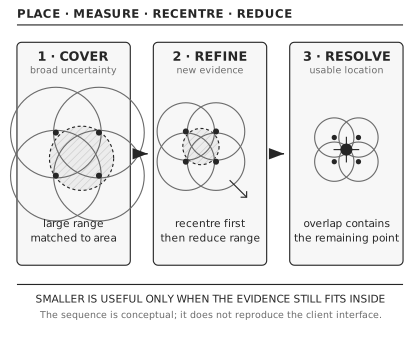
The Solar System map visualises both probes and Signatures. Moving the probes changes the space being measured. Resizing them changes the scale at which that space is examined.
A broad range is useful when the possible location is broad. It covers more space, but asks a less focused question. A smaller range can support a more precise answer when the remaining uncertainty fits inside it.
Smaller is not automatically better. A narrow formation placed beside the indicated area asks a precise question about the wrong space. The absence of a good result then belongs to the placement, not necessarily to the Signature.
Overlap gives the pattern meaning. The probes are not independent searchlights whose results can simply be added. Together they form a measurement geometry around the target area. The useful centre is where that geometry and the remaining uncertainty meet.
Range and position therefore remain different actions. Range controls the scale of the question. Position controls where the question is asked.
The Pathfinder should be able to explain the next change in one sentence: The result is here, the uncertainty is this large, and the next formation will measure that space more closely.
Precision is not produced by shrinking alone. It is produced by matching the geometry to the evidence already obtained.
Three Scan Qualities
Three values describe the current Scanning capability:
Scan Strengthsupports the ability to resolve difficult results.Scan Deviationdescribes the positional uncertainty that can remain in a result.Scan Durationdescribes how long a measurement takes.
The displayed values include bonuses from Skills, Ships, Modules, Rigs and Implants. They describe the capability brought to the measurement, not the quality of the pilot’s present probe placement.
Better equipment cannot make misplaced probes cover the target. Good geometry cannot guarantee that a poorly prepared Scanning platform will resolve every difficult Signature. The equipment and the arrangement answer different parts of the same problem.
For a Pathfinder, the practical lesson is not to memorise a perfect fitting in this chapter. The pilot must recognise where improvement must occur. A result limited by poor placement calls for a better measurement. A result repeatedly limited despite sound placement may call for more capability, more time or a different pilot.
Progress Is Evidence
The result display makes progress visible. At the final state, a Cosmic Signature is both fully resolved and warpable. Before that point, the changing result records how the search is narrowing.
Treat that progress as evidence, not encouragement. A higher value says that the latest measurement supports a more resolved position. No conclusion follows about whether the site is safer, closer or more valuable.
The distinction matters most when the result begins revealing a Group or more specific information. A label can change the priority of the search. It still does not replace the final location or the observations that must be made after arrival.
The current client can also provide additional information through Probe Scanner tooltips, including known site names. Such information helps the pilot interpret the result, but a partial result remains unwarpable.
A Pathfinder can stop before full resolution when the revealed information is enough to show that the Signature does not serve the present task. That is not a failed scan. It is a search ended by a decision.
The opposite is also true. Reaching a warpable result completes the location problem, not the operational judgement. The next question belongs to entry, observation and risk.
Filters Change Silence
Filters can hide results and allow Signatures to be ignored. This is useful in a crowded system. It is also another way for the interface to look quieter than the system is.
A filtered result has not disappeared from space. It has disappeared from the current view. An ignored Signature has not been resolved as irrelevant for all pilots and all operations. It has been set aside in this working context.
Filtered results can be restored through Show. The interface therefore
distinguishes between there are no results and no results are being shown.
That distinction should survive in the Pathfinder’s thinking. Before reporting an empty Probe Scanner, inspect the filters and ignored results. State the configuration with the Observation when it matters.
No Cosmic Signatures are shown with this filter is narrower and more useful than there is nothing here. It also tells the next pilot what must be checked before relying on the Report.
Filters reduce noise. They do not reduce the system.
Probes Are Return
In Known Space, running out of Core Scanner Probes may end an exploration attempt. In Anoikis, it may remove the ordinary means of locating an exit.
An ample probe supply therefore belongs to navigation, not merely inventory management. Probes are part of the Pathfinder’s ability to turn an unresolved way out into a usable location.
The client recovers deployed probes automatically when the ship jumps to another system or docks. That convenience should not be mistaken for a promise under every interruption. Downtime does not recover them, and lost probes may only be reconnected while their limited lifetime still permits it.
The Reconnect to Lost Probes function can repair some client interruptions.
It cannot create probes that are no longer recoverable. Spare probes preserve a
capability that recovery tools may fail to restore.
Record this in the same category as fuel, Bookmarks and the health of the return connection: a resource can be present now and still require protection before the route depends on it.
The important question is not whether probes were launched. It is whether the Pathfinder will retain the means to resolve the next connection if the plan changes.
Record the Search
A useful Scanning record preserves the difference between a possibility and a location. At minimum, keep together:
- the visible Signature identifier or result being worked;
- the latest resolved information shown by the client;
- whether the result is partial or warpable;
- the Timestamp of the measurement; and
- the Source when the result came from another pilot.
Do not promote a partial result in the Shared Map merely because the likely answer seems obvious. Record the degree of resolution honestly. The next pilot may have better Scanning capability, a different purpose or a fresher view of the system.
Once a location is resolved, its continued usefulness depends on what happens next. Chapter 7 will establish Bookmark Discipline. Until then, retain the essential distinction: a result in the Probe Scanner and a position preserved for later use are not the same record.
A scan can be exact enough to warp now and still be poorly preserved for the return. The work is complete only when the information survives the moment in which it was produced.
Stop With Purpose
Not every Signature must be resolved during every visit. Completeness has a cost in attention and time.
The Pathfinder may be searching for a route, checking whether a reported connection still exists or building a full picture for a later operation. Each purpose requires a different stopping point.
Stopping because the Group is irrelevant can be sound. Ending the attempt because the present capability cannot resolve the Signature can also be sound, if the limit is recorded. Repeated passes that have become habit are not a decision.
Before ending the search, ask:
- What question has the scan answered?
- What remains only indicated?
- What must another pilot repeat or complete?
- What route or decision now depends on this result?
These questions keep an unfinished scan useful. They also prevent a fully resolved position from carrying more authority than it deserves.
Scanning does not finish when the bar turns complete. It finishes when the Pathfinder knows what the result supports and what action should follow.
Field Principle
A scan result is a measurement of hidden space, not a judgement upon what it contains. Progress describes resolution. Filters describe the present view. The final state supplies a location, not safety.
Place the probes around the evidence. Change one question at a time. Preserve the answer at the level the client actually provided.