The Pathfinder retreats through the Wormhole and reaches the familiar side. The danger appears to be behind the ship.
Two minutes later, the situation changes. The pilot attempts to return through the same connection. The Wormhole refuses the transit.
The connection still exists. Its mass state still supports the hull. The short Session Change ended long ago. What blocks the ship is a history created by the pilot’s own earlier movement.
Polarization makes a Wormhole remember direction. Understanding that memory means replacing the idea of two quick jumps with two separate clocks.
Two Directional Clocks
For a particular pilot and Wormhole connection, each direction keeps its own five-minute transit history.
Call the systems A and B. A transit from A to B begins the A-to-B clock for that pilot on that connection. The pilot can return from B to A after the Session Change because that return is the first transit in the opposite direction. It begins a separate B-to-A clock.
The clocks do not cancel one another.
After the pilot reaches A, an immediate attempt from A to B meets the first A-to-B history while it is still active. The Wormhole refuses that same-direction repeat until five minutes have passed from the earlier transit.
For that reason, I jumped twice is an unreliable summary. The relevant record is:
- which pilot;
- which Wormhole;
- which direction; and
- what time the last successful transit in that direction occurred.
Polarization is not a property of the side on which the ship waits. Instead, it relates the pilot’s transit history to the next direction being attempted.
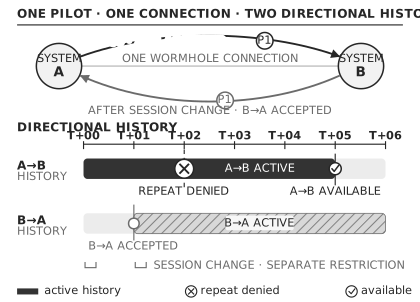
First Transit
The first transit through a connection in a direction usually feels unrestricted because no recent same-direction crossing exists to block it.
That success creates the condition for a later refusal.
Suppose the Pathfinder crosses A to B at 12:00. The ship arrives in B. The A-to-B direction will not accept another transit by that pilot until 12:05. This restriction matters even though the ship is presently on the B side and cannot immediately attempt A to B.
The hidden relevance appears after a return.
At 12:01, the pilot travels B to A. That movement is allowed because it is the first B-to-A transit in the period. It begins a B-to-A history lasting until 12:06. The ship is now back in A with both directions carrying different times.
Nothing about the arrival display says the route has reset. Physically returning to the starting system does not return the pilot to the starting state.
Record the first transit because it is the beginning of future constraint, not because it caused a problem at the time.
The Third Jump
At 12:02, the Pathfinder attempts A to B again.
The connection is present. The hull may fit. Sufficient mass capacity may remain. The ten-second Session Change has ended. The jump still fails because the pilot already travelled A to B at 12:00.
At 12:05, the A-to-B direction becomes available. A successful transit then starts a new A-to-B five-minute history.
The other clock has not followed it. On arrival in B at 12:05, the B-to-A direction still reflects the transit made at 12:01 and remains unavailable until 12:06.
One minute can now separate the pilot from a return that looked immediate.
This sequence is the simplest reliable model:
- 12:00 — A to B succeeds; A-to-B available again at 12:05.
- 12:01 — B to A succeeds; B-to-A available again at 12:06.
- 12:02 — A to B is refused.
- 12:05 — A to B succeeds and begins a new A-to-B history.
- 12:06 — B to A becomes available from its own earlier transit.
The exact clock times will vary. The separation between directions does not.
Read the Refusal
When Polarization blocks a transit, the client reports the refusal and can show the remaining restriction.
That message is valuable evidence. It distinguishes Polarization from a collapsed connection, ship-size limit, Session Change or another suspected cause. It also gives the pilot a present boundary for the attempted direction.
The message arrives after the pilot has already depended upon the jump.
For that reason, refusal should not be the normal method of discovering the timer. A ship testing the Wormhole under pressure may be exposed on the Grid while the expected exit is unavailable. A fleet may split when some pilots cross and others learn their histories are different.
Use the client indication to correct the record. Do not use it as permission to forget the earlier transits.
If an expected time and the displayed restriction disagree, trust the current client state for the immediate decision and mark the manual record uncertain. Tracking exists to anticipate the mechanic, not to argue with the server.
Pilot, Not Ship
Polarization applies to the pilot rather than to the hull or account as a single shared state.
Changing ships does not clear that pilot’s history through the connection. A different pilot using the same hull carries their own history instead.
This distinction prevents a dangerous repair attempt. When a jump fails, the Pathfinder may suspect the ship and consider swapping hulls. A pilot Polarized in that direction gains nothing from a new hull.
It also explains why two pilots arriving together may receive different answers from the same Wormhole. Their ships can be identical, and their connection state can be shared, while their personal transit histories differ.
Fleet reports should therefore avoid the hole is Polarized. The connection does not impose one universal clock upon everyone.
Say who is affected and in which direction:
Pathfinder One: A-to-B available at 12:05. Pathfinder Two has no recorded A-to-B transit.
The grammar matters because the mechanic belongs to the subject.
Connection Specific
The directional history belongs to the particular Wormhole used.
A pilot blocked from A to B through one connection is not thereby blocked from using every other Wormhole in the system. Another available edge carries its own transit history and its own mass and lifetime conditions.
This does not automatically make the alternative safe. It may lead somewhere else, lack usable endpoint Bookmarks or depend on an older report. It may lengthen the Chain or expose the ship to another Grid.
Still, the distinction matters during recovery. The return is blocked may mean this pilot cannot presently take this direction through this connection. That statement does not necessarily mean the system has no route.
Maps should keep connection identity precise enough for timers to attach to
the correct edge. A vague label such as home hole becomes risky when a
replacement connection appears or the Chain has several routes towards Home.
Polarization depends on identity. If the record cannot distinguish the Wormhole, it cannot preserve the clock.
Session Change
The ten-second Session Change after a Wormhole jump and the five-minute directional history are separate mechanics.
Session Change creates a short restriction immediately after each transit. It can prevent the first return even though that opposite direction has no recent history. Once the Session Change ends, the return may succeed and begin the second directional clock.
Polarization becomes relevant when a pilot attempts the same direction again within its five-minute window.
The timescales make confusion easy. A pilot waits until another jump command becomes available, returns successfully and concludes that all restrictions ended. Only the short one ended. The original direction can remain blocked for several more minutes.
Keep the concepts separate in reports:
- Session Change active describes the immediate post-transit state.
- A-to-B Polarization until 12:05 describes directional history.
Both can affect movement. They answer different questions and expire on different schedules.
Mass Is Separate
Polarization does not describe the Wormhole’s remaining capacity.
The pilot may be clear to travel while the connection can no longer support the ship or collapses. The Wormhole can remain healthy while that pilot is Polarized. A successful transit affects mass state and starts directional history at the same time, but those consequences are not the same mechanism.
This separation matters when planning a return.
Waiting for Polarization to end spends connection lifetime and allows other traffic to consume mass. Confirming the timer does not preserve the door. Rechecking the Wormhole state does not clear the pilot.
Before depending on a transit, the Pathfinder needs both answers:
Can this connection still carry the ship?
Can this pilot travel in this direction now?
The first is about the Wormhole and hull. The latter concerns the pilot’s history.
A plan that records only one can fail despite being correct about it.
Fleets Desynchronise
A group rarely shares identical clocks for long.
The scout may have crossed the connection earlier. Another pilot may have joined from the far side. A third may have returned during a warning while the others stayed. When the Fleet Commander later calls for movement, the pilots stand on the same Grid with different directional histories.
The Wormhole can therefore divide the group without changing visibly.
Before coordinated movement, pilots whose recent transits matter should report them. The report needs connection, direction and time. Silence should not be interpreted as clear history unless the group has established that meaning.
When the fleet must cross under pressure, verify the movement in stages. A successful first transit does not prove the remaining pilots can follow. A failed transit should be reported immediately with the affected pilot and remaining time, not merely as can’t jump.
Shared timing creates options. The group can wait, change order, use another route or abandon a commitment before the first ships cross.
Unshared timing turns a mechanical restriction into a surprise at the threshold.
Escape Can Fail
Polarization becomes most dangerous when a route is treated as an unconditional escape.
A pilot crosses to inspect the far side, returns after seeing a threat and later moves back towards the Wormhole expecting to flee through it again. The object is visible. The Bookmark is correct. The Wormhole has not collapsed. The intended direction is still unavailable.
The failure began at the earlier transit, not at the moment of pursuit.
Every escape plan through a recently used Wormhole should include time. If the direction may be blocked, the pilot needs either enough room to wait, another route, another position or a decision not to enter the exposure at all.
The threat does not need to know the exact timer to exploit it. Pressure near the connection can force the pilot to attempt the unavailable direction. Experienced opponents may also infer likely histories from observed traffic.
An exit Bookmark preserves where the door is. Polarization tracking preserves whether this pilot can use it in the intended direction.
Neither replaces the other.
Record Each Transit
The smallest useful record is a successful transit with pilot, connection, direction and time.
Connection notes can live on the Shared Map. An operational timeline can hold fleet movement. A solo Pathfinder may use visible client timestamps or a compact field note. The tool matters less than whether the next decision can recover the history.
A directional label should be unambiguous from the current map. Home to Chain and Chain to Home can work when both endpoints are stable and shared.
System identifiers are safer when aliases may change.
Do not record only the expected expiry. Record the transit that produced it. If the clocks later disagree, the group can reconstruct the reasoning. An expiry without its Source looks authoritative even after the wrong edge was selected.
Failed attempts should not be mistaken for successful transits. Record the refusal when it affects the operation, but do not let it replace the last known crossing in that direction.
Time is not paperwork added to movement. For Polarization, time is part of the route.
Wait With Purpose
Sometimes the correct decision is simply to wait.
Waiting for a directional history to expire can restore the intended transit. The rest of the system does not freeze. The connection continues to age. Other ships can cross. The local Grid can change. The pilot’s position may be observed.
Choose the waiting position with those facts in mind.
The safest available place depends on ship, cloak, Grid, known contacts and route. This chapter cannot provide one universal position. It can provide the question:
What can change during this interval, and which of those changes would make the planned transit unacceptable even after the clock clears?
Use the interval to refresh the relevant picture. Recheck Directional Scanner evidence. Watch the Wormhole state if it remains observable. Confirm the alternative route and tell the group when the intended direction becomes available.
Waiting is an action when it protects a later choice. It becomes drift when the pilot watches the timer and allows every other condition to age unseen.
Rebuild the Picture
The end of Polarization answers one question: the pilot is no longer blocked by that directional history.
A cleared clock confirms neither the far Grid, the Wormhole’s capacity, the destination, the Shared Map nor the presence of other pilots. Those observations may be five minutes older than they were when the wait began.
Before transit, rebuild the smallest picture the commitment requires.
Confirm the connection identity. Read its current Information if condition matters. Refresh the Directional Scanner with settings suited to the Grid. Check whether the route beyond the Wormhole is still the route the plan expects. Preserve any new Unknown instead of letting the cleared clock stand in for all of them.
Then decide again.
Polarization teaches a broader survival lesson. A single action can leave behind state that is invisible in the ship’s present position. That state must travel forward until it expires or is replaced by a new Observation.
The timer may be over. The world that elapsed alongside it is not.
Field Principle
Polarization is a five-minute same-direction restriction belonging to one pilot on one Wormhole connection. The opposite direction keeps its own history. Returning does not reset the first clock.
Record every relevant transit by pilot, connection, direction and time. Keep Polarization separate from Session Change and Wormhole mass. Before depending on the next jump, confirm both the pilot’s history and the door’s current state.