The Wormhole has been resolved, warped to and inspected. Its information suggests a destination the Pathfinder is prepared to enter. The connection does not appear close to failure. Nothing on the Grid has yet made the crossing unacceptable.
The next command is short. Its consequences are not.
Entering Anoikis changes which side of the connection holds the ship, which observations remain current and which route the next decision depends upon. The Wormhole may survive the transit, change state under the added mass or collapse after it. The arrival Grid may be quiet, occupied or already prepared for the ship that appears.
No entry procedure can remove those possibilities. Good entry work keeps them separate long enough for the Pathfinder to understand what has changed.
The crossing begins before the jump command. It begins when the pilot decides which Unknowns can travel with the ship and which must be reduced first.
A Real Commitment
The Wormhole does not offer a view into the destination. Its information can indicate the nature of the other side and the condition of the connection, but the arrival itself remains unobserved until someone crosses.
That makes entry an information boundary. Before transit, the Pathfinder knows the departure Grid, the current side of the Wormhole and the observations collected there. After transit, the client supplies a different system and a different Grid. Some earlier conclusions survive. Others have already begun to age.
The ship also becomes part of the connection’s history. Its mass is added to the total carried. The pilot begins a new Session Change. The first transit in a direction becomes relevant to Polarization. Even a small scout has altered the conditions it may need for return.
This is why I can jump and I should enter are different statements. Capability answers whether the client will accept the transit now. Judgement asks whether the ship, route and purpose can tolerate what the other side may reveal.
A useful entry decision can be expressed plainly:
The connection supports this ship, its observed state supports this commitment, and the pilot retains a way to continue or recover if the destination is worse than expected.
If one part of that sentence is only hoped for, the crossing carries more uncertainty than the display suggests.
Read Before Crossing
The last quiet moment on the departure side is the time to gather facts that will otherwise become memory.
Read the Wormhole Information again. The relevant Observation is the state closest to the decision, not the state reported when the Signature was first resolved. Confirm the destination clue, the maximum ship-size indication, the Reliable Lifetime and the mass condition. A report from another pilot may have been correct when written and still be too old for this transit.
Then read the ship. The fitted probe launcher matters only if usable probes are available. A cloak matters only if the pilot understands what action will break protection. A prepared return Bookmark matters only if it names this side of this connection clearly enough to be recognised under pressure.
Finally, read the operation. Is the ship testing a connection, extending a Chain or carrying something the group cannot casually lose? Is another pilot expected to follow? Does the plan depend upon this same Wormhole for return?
None of this inspection creates delay for its own sake. It establishes what the crossing is allowed to risk.
An inexpensive scout may accept an Unknown arrival because the purpose is to observe it. A larger commitment may require a fresher connection state, another route or a scout already waiting beyond the Wormhole. The destination has not changed between those cases. The consequence of a poor answer has.
Separate Both Sides
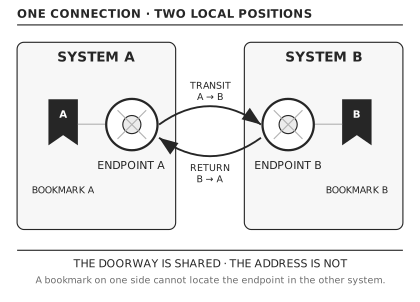
One connection has two visible ends. They belong to different systems, occupy different positions and may carry different local identifiers.
The Wormhole seen before entry is not the object that will appear behind the ship after entry. They represent the same connection, but they are not the same saved position. A Bookmark on one side cannot substitute for a Bookmark on the other.
This distinction is easy to lose because language compresses both ends into one phrase: the hole. That shorthand is harmless while everyone shares the same context. It becomes dangerous when a label, report or map must tell a pilot where to warp.
Before crossing, the Pathfinder should know how the departure end is recorded. After crossing, the arrival end must receive its own record. The two records can then be related through the Shared Map.
Think of the connection as a door with an address on each face. The doorway is shared. The address is not.
This model also protects later corrections. If a Signature identifier or local Bookmark is wrong on one side, the other side can remain valid. If the connection collapses, both endpoint records can be retired without deleting the systems they once related.
Keeping the ends separate is not administrative neatness. It is what allows a map to answer the practical question: Which position in this system leads where I intend to go?
Use the Pause
Chapter 1 introduced the two conditions that follow a transit. Entry turns that knowledge into a decision window without turning the conditions into one mechanic.
The ten-second Session Change restricts another jump and several other actions. Post-jump protection lasts until a ship command ends it or sixty seconds have passed. Session Change limits action; post-jump protection delays exposure.
Let the Grid finish loading. Identify the return Wormhole and the System Identifier. Notice the objects, Effects and warnings that differ from the departure-side picture. The useful question is not How quickly can I issue the next command? It is Which command should end this protection?
An immediate return, movement, cloaking and Warp all spend the pause differently. Waiting without observing wastes it; acting by reflex discards it. Use the interval to choose without asking the interval to make the choice safe.
Read the Arrival
The departure-side plan carried expectations. The first Grid tests them.
Start with difference. Confirm the system actually reached and the return Wormhole now behind the ship. Note visible contacts, deployed objects, wrecks or Effects that alter the immediate picture. Then compare the arrival with the Report or Shared Map that supported entry.
The Overview and Local retain the limits established earlier; arrival does not remove them. Clearing the whole system from one Grid is impossible. Instead, find which expected facts still hold and which new Unknown can change the next command.
Agreement supports the route record. Disagreement is even more useful: it identifies the exact part of the old picture that needs attention. The arrival is not a verdict on the earlier Report. Treat it as a new Observation taken after a state-changing event.
Preserve the Exit
Before the Pathfinder allows the Wormhole to leave the Grid, its arrival-side position must be preserved.
The scan result on the departure side cannot do this. It describes a position in the previous system. Nor should a pilot assume that the client will create a usable record of the entry automatically. The return object now visible behind the ship is the evidence available on this side.
Save that object as a Bookmark while the relationship is unambiguous: this is the Wormhole through which the ship just arrived. A polished label can wait if the situation demands attention. The position cannot be reconstructed from memory after the ship has warped away.
The first label should communicate function before detail. It should tell the pilot that this Bookmark leads back along the connection just used. Chapter 7 will develop the naming and sharing discipline. At the threshold, the essential result is simpler:
The exit is preserved, it is distinguishable from other Wormholes in the system, and its meaning is not stored only in the pilot’s memory.
After saving, verify the record. A window closing is not proof that the Bookmark entered the intended folder, received the intended expiry or is available to the people expected to use it. Under pressure, preservation comes first; confirmation follows as soon as the arrival permits.
A route Home can survive an untidy label for a minute. It cannot survive a missing position.
Polarization Begins
Every Wormhole transit also starts a directional Polarization history for that pilot and that connection.
The current rule prevents a pilot from travelling through the same Wormhole in the same direction twice within five minutes. An initial passage from system A to system B does not prevent an immediate passage back from B to A once the Session Change has ended. That return is the first transit in the opposite direction.
A third passage may be different. If the pilot tries to travel from A to B again before five minutes have passed since the first A-to-B transit, the Wormhole refuses the jump. The B-to-A direction keeps its own history.
This matters during first entry because a quick retreat can look like a reset. It is not. The ship may be back where it began while the pilot has created two different directional timers. A later attempt to escape through the same connection can fail on the side where the pilot expected it to work.
Polarization belongs to the pilot, not to the hull as a general property. It also belongs to this particular Wormhole, not to every connection in the system.
Chapter 11 will examine the mechanic in depth. For entry, retain the part that changes decisions immediately: record the transit time, distinguish the two directions and never assume that returning through a Wormhole erased the first jump.
Mass Crosses Too
The ship does not pass through a neutral doorway. Its transit consumes part of the Wormhole’s total mass capacity.
The Information Window gives rough mass-state messages rather than an exact remaining value. Those messages may show that the connection was not yet heavily reduced without revealing how close the next meaningful threshold lies. Other ships may also have crossed since the last observation.
This creates two obligations.
First, never report the pre-entry state as though it were observed after the ship crossed. The transit itself is a reason to consider the earlier record aged. If the connection matters to following ships, observe its state again and Timestamp the update.
Second, count the return as another transit. A decision to enter and come straight back is not one use of the Wormhole. It is two movements of ship mass through the connection.
For a small Pathfinder hull, the individual contribution may seem unimportant. The habit cannot depend on the hull being small. Fleets, industrial traffic and deliberate mass reduction all magnify the same mechanic. Recording only dramatic transits in the Shared Map teaches the group to forget how the total was accumulated.
The book does not ask the beginner to estimate exact remaining mass from rough messages. It asks for an honest distinction: mass observed before the transit, traffic known since, and present state still Unknown until checked.
Decide From Arrival
Once the exit is preserved and the first picture has formed, entry ends in a decision rather than a ritual.
The Pathfinder can continue the survey, hold position, return, call for help or stop the operation. Each choice should follow from the same five questions:
- What is visible now?
- What expected information still agrees with the arrival?
- Which Unknown could change the next action?
- What route does the ship depend upon?
- What becomes harder to reverse after moving?
Continuing may be reasonable when the Grid is manageable, the return is preserved and the ship retains its Scanning capability. Returning may be reasonable when the Wormhole state is worse than reported or the destination does not serve the plan. An unexpected arrival threat can justify the same choice.
Neither result proves courage or failure. The purpose of a scout is to change the quality of the next decision. Sometimes the best information it can return is that the commitment should end here.
Do not allow sunk time to argue for movement. Resolving the Signature, warping to the Wormhole and crossing it do not create a debt that must be repaid by going deeper.
The arrival supplies new evidence. Let it revise the plan.
Return Is Valid
Beginners often imagine a successful entry as a smooth continuation into the system. That picture makes an immediate return feel like a mistake.
It may be the most disciplined outcome available.
A Pathfinder who finds an unexpected destination or an unhealthy connection has still completed the purpose of entry. The same is true after finding an unusable shared record or occupied arrival Grid. In every case, the Unknown beyond the Wormhole has been reduced before the operation commits more.
Return still requires care. The Session Change must have ended. Polarization history must be understood. The Wormhole must still support the ship. The departure side may also have changed while the pilot was away.
An abort is therefore not a reversal of time. It is another transit made under new conditions.
Report what caused it. Returned because the route felt wrong gives the next pilot little to use. Returned after observing an unexpected system, unconfirmed exit Bookmark and two ships on the arrival Grid at this Timestamp preserves the decision and its supports.
This is how caution becomes operational knowledge instead of private anxiety.
Success does not require the ship to remain beyond every threshold. It requires the pilot to know why the ship is on either side.
Field Principle
Entry moves more than a ship. It changes the available observations, adds mass to the connection and begins a directional history the pilot may later depend upon.
Read the door before crossing. Use the arrival pause. Preserve the exit before leaving its Grid. Continue only from the picture the new system actually provides.